
Essays in Idleness: A Philosophical Stroll with the Monk Kenkō
Translated from French • English (anglais)
A jewel of hermitage literature, Essays in Idleness (Tsurezure-gusa)1Rejected forms:
Cahier des heures oisives.
Variétés sur des moments d’ennui.
Variétés sur des moments de désœuvrement.
Réflexions libres.
Écrit dans des moments d’ennui.
Propos des moments perdus.
Les Herbes de l’ennui.
Les Divers Moments de loisirs.
Tsourézouré Gouça.
Tsure-dzure-gusa.
Tsouré-dzouré-gousa. is a timeless invitation to seize the fleeting beauty of the world before “the dew on the plains of Adashi” dries and “the smoke of Mount Toribe” fades away (ch. VII)2Located northwest of Kyoto, the plains of Adashi once served as a vast cemetery where bodies were left to the elements. Mount Toribe, situated to the southeast, was the site of cremations.. The author, Urabe Kenkō or the monk Kenkō (1283–1350)3Rejected forms:
Urabe Kaneyoshi.
Yoshida Kaneyoshi.
Yoshida Kenkō.
Yoshida Kennkō.
the abbot Kenko.
the bonze Kenkō.
the reverend Kenkō.
Kenkō the hōshi.
Kennkō hōshi.
Kenkō-bōshi.
Kenkō bōci., was neither a fierce ascetic nor even a devout in the narrow sense of the term. An officer of the guard, charged with attending Emperor Go-Uda, he chose to take religious vows only upon the death of his patron, and did so in order to observe his contemporaries from a distance. In an era when the “ruffians of Kantō,” uncultured soldiers, afflicted the court with a “way of life far removed from all humanity, closer to that of beasts” (ch. LXXX), Kenkō knew how to preserve the essential: the ancient taste.
“Kenkō […] is a belated classicist. […] his essays resemble the polished conversation of a man of the world, and possess that air of simplicity and ease of expression which are in reality the mark of a consummate art.
One cannot, when beginning the study of ancient Japanese literature, make a better choice than Essays in Idleness.”
Aston, William George. Littérature japonaise (Japanese Literature), trans. from English by Henry Durand-Davray. Paris: A. Colin, “Histoires des littératures” series, 1902. (Bibliothèque nationale de France (BnF)).
Upon examining this work rich in confidences, one discerns in Kenkō two contrasting personalities: the aristocrat and the monk. He advocates, to be sure, Buddhist detachment, yet confesses that “a man who had no taste for amorous life” would resemble a “crystal cup lacking a bottom” (ch. III). He criticizes attachment to material goods, yet always feels “a quickening of the heart” (ch. VIII) when recalling the palace décors, the accessories of costumes, or the magnificence of ceremonies. He rails against vulgar drunkenness, yet admits that a glass of sake shared among “intimate friends around the fire” (ch. CLXXV), on a snowy night, is one of life’s charms. These two facets of his character combine to “form a type of old bachelor [truly] sympathetic, and who becomes even more so when one meditates at leisure upon the thoughts and counsels, of such intimate wisdom, that fill the greater part of his writing,” explains Michel Revon. I hold him to be the greatest moralist, the most harmonious and purest spirit of Japan.
The Essence of Zuihitsu: Following the Caprice of the Brush
“Zuihitsu, ”following the brush“ […]. The bonze Kenkō composed the most beautiful book of this genre. He is my master. I went to Kyoto to weep at the place where he had lived. A bonze led me there. […] ”The abbot Kenkō,“ he said to me […], ”it is [the flowers] that are there!“ The Japanese are like the seasons; everything returns […] with them. We are like history; everything dies with us.”
Quignard, Pascal. Petits Traités (Short Treatises). Paris: Maeght, 1990; repr. Paris: Gallimard, “Folio” series, 1997.
Essays in Idleness belongs to that most particular literary genre, the zuihitsu (“following the brush”)4Rejected forms:
“Impressionist literature.”
“Following the caprice of the brush.”
“Writings following the brush.”
“Miscellanies.”
“Essays.”
“Essay following the brush.”
“Essay following the pen.”
“Notes taken at the flow of the pen.”
“At the flow of the brush.”
“Letting one’s brush go.”
“At the whim of the brush.”
Zouï-hitsou., in which the Japanese also place Montaigne’s Essays. And this comparison between Kenkō and our French gentleman, however conventional, is no less apt. One finds in both that sure and delicate taste, that melancholy which is never despair, that wholly humanist enthusiasm not so much for Antiquity as for ancient virtue, and finally that will to paint oneself while painting others. No regular plan, no system to confine the mind; nothing but the caprice of the brush, from which emerges a “jumble of reflections, anecdotes, and maxims thrown pell-mell onto paper, over [several] years, around 1335,” a garden of impressions where wild grass grows alongside rare flowers. The famous incipit sets the tone for this intellectual stroll:
“At the mercy of my idle hours (Tsurezure naru mama ni), from morning to evening, before my writing desk, I note without precise design the trifles whose fleeting reflection passes through my mind. Strange digressions!”
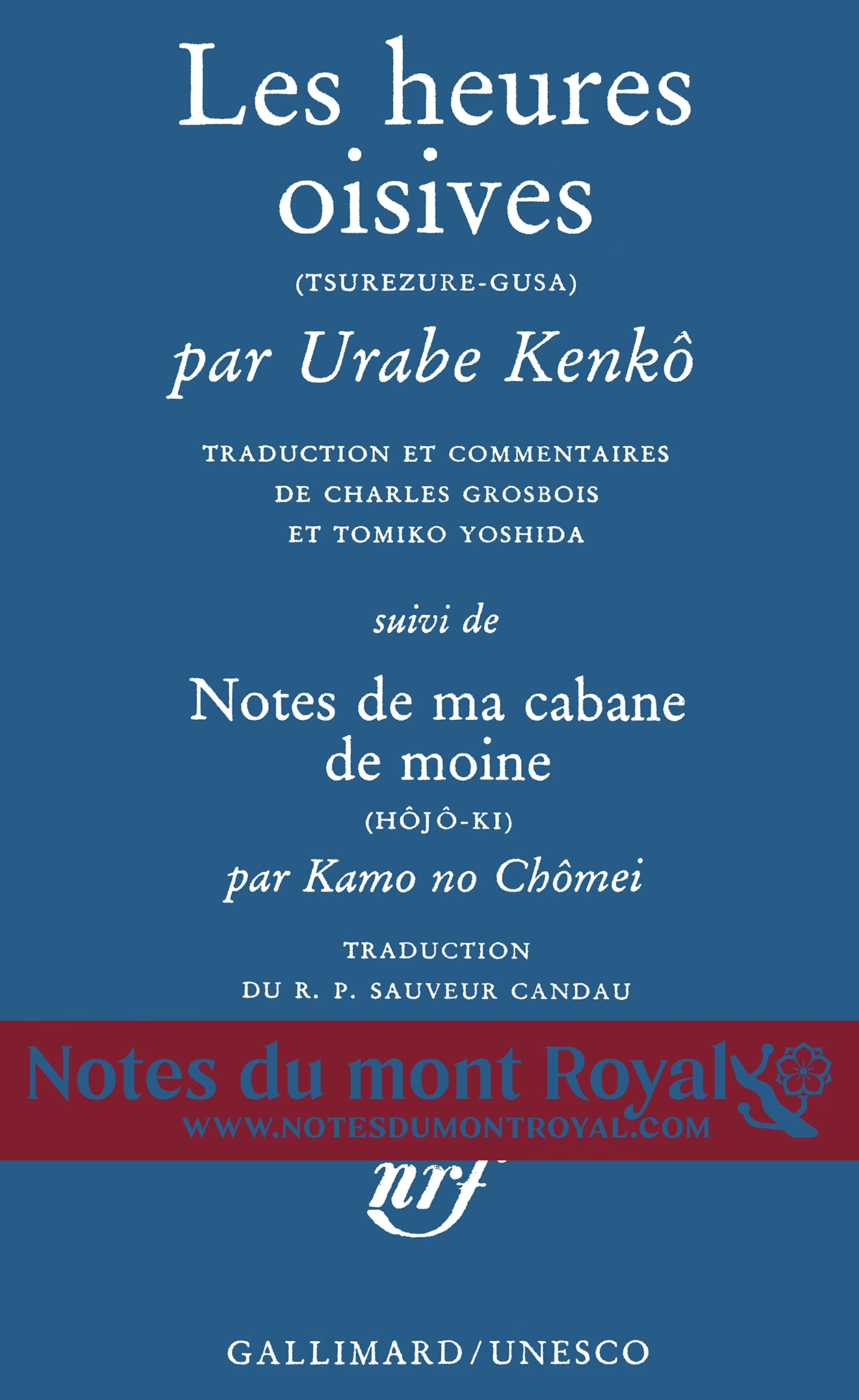
Urabe, Kenkō. Les Heures oisives (Essays in Idleness) (Tsurezure-gusa), trans. from Japanese by Charles Grosbois and Tomiko Yoshida. Paris: Gallimard, “Connaissance de l’Orient. Série japonaise” series, 1987; partial repr. under the title Cahiers de l’ermitage (Notebooks from the Hermitage) (pref. Zéno Bianu), Paris: Gallimard, “Folio Sagesses” series, 2022.
The Poetics of the Unfinished
At the heart of Essays in Idleness beats the poignant sense of the ephemeral. For modern man, the flight of time is, most often, a source of anguish; for Kenkō, it is the very condition of beauty. “It is its impermanence that makes this world precious” (ch. VII), he writes. If our existence were to be eternal, the poetry of the world would vanish at once. From this philosophy of precariousness flows an entirely Japanese aesthetic, that of the unfinished, which prefers to the fullness of the moon the veiled brilliance of a waning star; and to the flower in full bloom the petals that the wind carries off in haste, despite ourselves:
“Whatever the object, its perfection is a defect. Leave things unfinished, as they are, without polishing: I shall find interest in them and feel at ease. I have been told: when one builds an imperial residence, it is customary to leave one spot unfinished.”
Urabe, Kenkō. Les Heures oisives (Essays in Idleness) (Tsurezure-gusa), trans. from Japanese by Charles Grosbois and Tomiko Yoshida. Paris: Gallimard, “Connaissance de l’Orient. Série japonaise” series, 1987; partial repr. under the title Cahiers de l’ermitage (Notebooks from the Hermitage) (pref. Zéno Bianu), Paris: Gallimard, “Folio Sagesses” series, 2022.
By teaching us that “the regret for the scattering of flowers and the waning of the moon” (ch. CXXXVII) is more touching than the praise of their full blossoming, Kenkō does not merely offer us a lesson in poetics; he offers us, better still, a consolation.
Further Reading
Around Essays in Idleness
Quotations
“世の人の心まどはすこと色欲にはしかず。人の心はおろかなるものかな。にほひなどはかりのものなるに、しばらく衣裳にたきものすと知りながら、えならぬにほひには心ときめきするものなり。久米の仙人の、物洗ふ女のはぎの白きを見て通を失ひけむは、まことに手あしはだへなどのきよらに肥えあぶらつきたらむは、外の色ならねばさもあらむかし。”
徒然草 (國文大觀) on Wikisource 日本語, [online], accessed December 4, 2025.
“Nothing is worse for leading astray the hearts of men than sensual desires. The human heart: what a foolish thing!
Consider! A perfume is an evanescent thing, yet though we know that the scent of incense on a costume lasts but a moment, we always feel a quickening of the heart when we inhale an exquisite fragrance. What is told of the hermit of Kume5The hermit of Kume (Kume no sennin) had acquired, through his purity, the power to ride the clouds. But one day, while gliding above the Yoshino River, he was so troubled by the legs of a comely and scantily clad washerwoman that this profane thought he allowed himself made him suddenly fall from the heights. who lost his magical power at the sight of the whiteness of a washerwoman’s legs seems entirely natural to me, for skin, arms, and legs of full form are most powerful realities.”
Urabe, Kenkō. Les Heures oisives (Essays in Idleness) (Tsurezure-gusa), trans. from Japanese by Charles Grosbois and Tomiko Yoshida. Paris: Gallimard, “Connaissance de l’Orient. Série japonaise” series, 1987; partial repr. under the title Cahiers de l’ermitage (Notebooks from the Hermitage) (pref. Zéno Bianu), Paris: Gallimard, “Folio Sagesses” series, 2022.
“Nothing leads astray the hearts of men of this world as much as carnal passion. The heart of man is ridiculous in this regard. Although we know that perfume is but a borrowed thing, an incense with which garments have been imbued for a very short time, nevertheless the heart beats faster when one smells the exquisite fragrance. The hermit of Koumé, seeing the white leg of a woman doing laundry, lost his supernatural power; and this is understandable, for the elegant and plump appearance of arms, legs, and skin is not a foreign quality.”
Revon, Michel. Anthologie de la littérature japonaise : des origines au 20e siècle (Anthology of Japanese Literature: From the Origins to the 20th Century). Paris: Delagrave, “Pallas” series, 1910.
“Nothing leads us astray as much as sexual passion. Man is ridiculous in this regard; but our hearts beat faster when the sweet scent of perfume reaches us. A hermit named Koumé lost his supernatural knowledge upon seeing the white legs of a woman washing. One can conceive that even a hermit might be seduced by the pretty, plump legs of a woman.”
Ishikawa, Takéshi. Étude sur la littérature impressionniste au Japon (Study on Impressionist Literature in Japan). Thesis for the doctorate of the University of Paris. Paris: A. Pedone, 1909.
Downloads
Printed Works
- Traduction partielle de Les Heures oisives par Michel Revon (1910) (Partial translation of Essays in Idleness by Michel Revon (1910)). (Bibliothèque nationale de France (BnF)).
- Traduction partielle de Les Heures oisives par Michel Revon (1918) (Partial translation of Essays in Idleness by Michel Revon (1918)). (Google Books).
- Traduction partielle de Les Heures oisives par Michel Revon (1923) (Partial translation of Essays in Idleness by Michel Revon (1923)). (Google Books).
- Traduction partielle de Les Heures oisives par Michel Revon (1928) (Partial translation of Essays in Idleness by Michel Revon (1928)). (Google Books).
- Traduction partielle de Les Heures oisives par Takéshi Ishikawa (1909) (Partial translation of Essays in Idleness by Takéshi Ishikawa (1909)). (Google Books).
- Traduction partielle de Les Heures oisives par Takéshi Ishikawa (1910) (Partial translation of Essays in Idleness by Takéshi Ishikawa (1910)). (Google Books).
Bibliography
- Aston, William George. Littérature japonaise (Japanese Literature), trans. from English by Henry Durand-Davray. Paris: A. Colin, “Histoires des littératures” series, 1902. (Bibliothèque nationale de France (BnF)).
- Quignard, Pascal. Petits Traités (Short Treatises). Paris: Maeght, 1990; repr. Paris: Gallimard, “Folio” series, 1997.
- Sieffert, René. La Littérature japonaise (Japanese Literature). Paris: Publications orientalistes de France, “Langues et civilisations. Littérature” series, 1973.
- Struve, Daniel and Tschudin, Jean-Jacques. La Littérature japonaise (Japanese Literature). Paris: Presses universitaires de France, “Que sais-je?” series, 2008.