The Manifold Voice of the People: The Song of the Faithful Chunhyang
Translated from French • English (anglais)
The title must be taken literally: The Song of Chunhyang (Chunhyangga)1Rejected forms:
Le Dit de Chunhyang (The Tale of Chunhyang).
Ch’un-hyang ka.
Choon Hyang Ga.
Čchunhjangga. is, first and foremost, a song. To grasp its essence, close your eyes and imagine a bare stage, occupied by a singer with a fan and a drummer. This duo alone suffices to embody pansori, that authentically Korean art form which Serge Kaganski situates “at the crossroads of theater, opera, performance, gospel, and the two-man-show.” The drum resounds and the raspy voice takes flight, punctuated by the fan that opens and snaps shut with a crisp click that sets the rhythm. Carried away, the audience responds in unison, like “a Baptist choir,” in an intense communion verging on trance.
Born thus upon the stage, this lyrical song became narrative and traveled, borne by oral tradition. Over the centuries, a myriad of anonymous authors enriched it, incorporating other tales of royal inspectors and forbidden loves. From this living matter eventually settled, layer upon layer, fixed texts, authoritative literary editions, the most famous of which are The Tale of Chunhyang (Chunhyangjeon)2Rejected forms:
Histoire de Tchoun Hyang (Tale of Tchoun Hyang).
Histoire de Tchyoun hyang (Tale of Tchyoun hyang).
Histoire de Tchun-hyang (Tale of Tchun-hyang).
Tchoun-Hyang-Djun.
Tchyoun hyang tjyen.
Tchun-Hyang Chòn.
Tchun-hyang djŏn.
Ch’unhyangdyŏn.
Ch’unhyangjŏn.
Choon Hyang Jun.
Choon-hyang-chon.
Choon Hyang Jon.
Chun-hyang-jon.
Ch’un-hyang Chŏn.
Chun-hyang-chun.
Chun-chyang-chun.
Czhun-hiang dzon.
Čchunhjangdžŏn., or gyeongpan edition, and The Song of the Faithful Chunhyang (Yeolnyeo Chunhyang Sujeolga)3Rejected forms:
L’Histoire de la constance de Chunhyang, femme fidèle (The Story of the Constancy of Chunhyang, Faithful Woman).
Yol-nyo Ch’un-hyang Su-jeol Ga.
Yeolnye Chunhyang Sujeolga.
Yeollyeo-Chunhyang-Sujeolga., or wanpan edition.
The Springtime Idyll
The plot tells of the love between Chunhyang (“Fragrant Spring”), daughter of a former courtesan, and Mong-ryong (“Dragon Dream”)4In some sources, rather than by his given name Mong-ryong, the hero is designated by the appellation Yi Doryeong. This form combines his family name Yi and the respectful title doryeong given to the unmarried son of a nobleman. In reality, it simply means “young Master Yi, young Yi.”
Rejected forms:
Ye Toh Ryung.
I-Toreng.
Ri To ryeng.
Lee Doryong., son of a noble governor. In Namwon, in Jeolla Province, just as the flowers begin to bloom, the young scholar abandons his father’s library to stroll in the open air. There, he catches sight of Chunhyang swinging on a swing. This first encounter is painted with the delicacy of the finest prints:
“She grasped the rope with her delicate hands, stepped onto the board, and took flight. […] The leaves of the trees accompanied her back and forth. The red of her skirt made a joyful splash against the surrounding greenery. […] Seen from the front, she was the swallow diving to catch mid-flight a peach blossom petal drifting toward the ground. From behind, she seemed a multicolored butterfly flying off in search of its mate.”
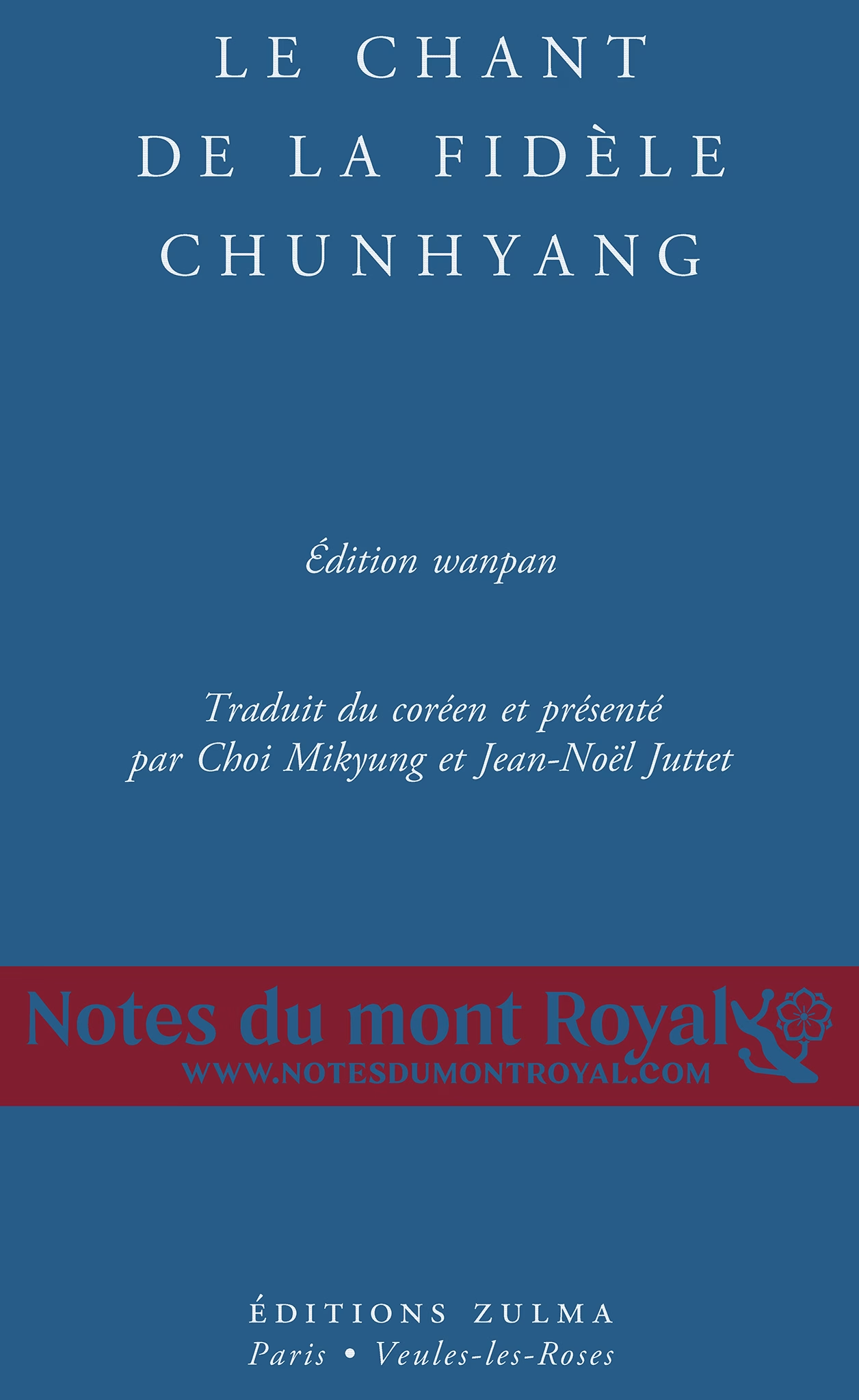
Le Chant de la fidèle Chunhyang (The Song of the Faithful Chunhyang), trans. from Korean by Choi Mikyung and Jean-Noël Juttet, Cadeilhan: Zulma, 1999; repr. Paris; Veules-les-Roses: Zulma, “Z/a” series, 2025.
Love, sudden and immediate, drives the young nobleman to defy convention. He goes to her home by night. Once across the threshold of her chamber, this daughter of the people proves herself no less educated and refined than he: the eye wanders over poems in her hand hung above her writing table, over calligraphies, paintings. It is in this setting that the lovers exchange their vows, sealing a union they still keep secret, separated as they are by birth and fortune.
The Trial of Constancy
In the meantime, Mong-ryong’s father is recalled to Hanyang (Seoul); the young man must follow him to complete his studies and sit for the mandarin examinations. He leaves behind a devoted and faithful wife who, a new Penelope awaiting her Odysseus’s return, swears to honor a “vow a thousand times more precious than gold, a thousand times more beautiful than jade.”
The drama unfolds with the arrival of a successor to the governorship, Byun Hak-do, a lustful and brutal man. Having heard of Chunhyang’s beauty, he demands that she enter his service. The roll call of the kisaengs possesses a Rabelaisian earthiness, where evocative names parade by, such as Miss “Mysterious Mist,” “Apricot Blossom,” or “River Fairy.” Only Chunhyang is absent. Dragged before the tyrant, she dares to stand up to him, arguing that a virtuous woman cannot serve two husbands, even if she be of low extraction:
“Do virtue and fidelity have anything to do with social rank?”
Le Chant de la fidèle Chunhyang (The Song of the Faithful Chunhyang), trans. from Korean by Choi Mikyung and Jean-Noël Juttet, Cadeilhan: Zulma, 1999; repr. Paris; Veules-les-Roses: Zulma, “Z/a” series, 2025.
For this insolence, she suffers torture. Each lash of the whip that falls upon her becomes the occasion for a song of resistance, a painful litany in which she reaffirms her loyalty. “Even if I am killed ten thousand times,” she proclaims, “the love that dwells in my heart, the love that binds the six thousand joints of my body, that love will not change.”
I shall say nothing of the denouement, except that it is a happy one.
The Triumph of Hearts over the Rigors of Arbitrary Power
The Song of the Faithful Chunhyang embraces the entire social scale of the Ancien Régime, from the highest for Mong-ryong to the lowest for Chunhyang. Its success lies in the fact that “it dared to speak aloud of love in this land where young hearts suffocated under authority” and where marriage, a matter of reason, was handled coldly without their having any say. This intimate claim is coupled with a political denunciation of the abuses and corruption that prevailed among the rulers.
I confess that the narrative sometimes suffers from the various additions it has inspired; the Bulletin critique du livre en français (Critical Bulletin of French Books) notes “some inconsistencies, clumsy justifications, […] naivety and sentimentality.” Yet, like a seashell that captures the murmur of the ocean, it preserves, beneath all this, “a whisper and something like a vast, muffled hum: the great infinite and manifold voice” of the poets of the people singing all around5To quote Hippolyte Taine and his magisterial Philosophie de l’art (Philosophy of Art).. Their vibrant souls, their good and pure feelings have carried this work through the centuries; they enliven it still today, during the great Namwon festival, where the finest myeongchang (master singers) compete. Lee Mee-Jeong reports that some of them practice with such ardor “in order to give their voice the perfection of expressiveness that they even spit blood.” Far from vain, their sacrifice is greeted by the audience, who rise to applaud, tears in their eyes. And “these tears of contemporary spectators are as moving as the tribulations and reunions of the fictional lovers.”
Further Reading
About Le Chant de la fidèle Chunhyang (The Song of the Faithful Chunhyang)
Quotations
“국가에 대경사로 태평과를 보이실 제 서책을 품에 품고 장중에 들어가 좌우를 둘러보니 억조창생 허다 선비 일시에 숙배한다. 어악풍류 소리에 앵무새가 춤을 춘다. 대제학 탁출하여 어제를 내리시니 도승지 모셔 내어 홍장 위에 걸어놓으니 글제에 하였으되, ”춘당춘색고금동“이라 두렷이 걸었거늘”
열녀 춘향 수절가 (Yeolnyeo Chunhyang Sujeolga) on Wikisource 한국어, [online], accessed September 25, 2022.
“A special civil service examination was to be held on the occasion of some celebration, and he decided to present himself. When, his Chinese books under his arm, he arrived within the academy grounds, he saw on all sides an immense crowd of common people and scholars. All made a deep bow when His Majesty the King appeared. Parrots fluttered to the rhythm of exquisite aerial music. His Majesty invited the dean of the Academy of Belles-Lettres to propose a subject, and the first secretary copied it onto a banner which he displayed before the eyes of the candidates. They were to compose on: ”At the Pavilion of Spring,6Or rather “the Pond of Spring” (Chundang, 春塘) and the vast esplanade overlooking it, where the examinations were held in the capital. the color of spring is the same today as of old.“”
Le Chant de la fidèle Chunhyang (The Song of the Faithful Chunhyang), trans. from Korean by Choi Mikyung and Jean-Noël Juttet, Cadeilhan: Zulma, 1999; repr. Paris; Veules-les-Roses: Zulma, “Z/a” series, 2025.
“One day, at last, he learned that the King of Korea had set the examinations for the day after next.”
Printemps parfumé : roman (Fragrant Spring: A Novel), trans. from Korean by J.-H. Rosny, with the collab. of Hong Chong-u, Paris: E. Dentu, “Petite collection Guillaume” series, 1892; repr. under the title Le Printemps parfumé ; suivi du Bois sec refleuri (Fragrant Spring; followed by The Withered Tree Blooms Again), ed. Benjamin Joinau (pref. Anthony de Taizé [An Sonjae]), Paris: L’Atelier des Cahiers, “Seonbi” series, 2017.
“A day came when he had but a single trial left to undergo.”
“L’Amour de I-Toreng et de la jolie Tchun-Hyang : roman” (“The Love of I-Toreng and the Lovely Tchun-Hyang: A Novel”), indirect trans. from French by Anonymous, based on that of J.-H. Rosny, La Revue des revues, vol. 14, 1895, pp. 60–68, 144–150, 233–238, and 327–332.
Downloads
Audio Recordings
- Partial reading of Le Chant de la fidèle Chunhyang (The Song of the Faithful Chunhyang) by Yun Yennie, in the translation by Choi Mikyung and Jean-Noël Juttet. (KBS WORLD Radio).
- Yun Yennie on Le Chant de la fidèle Chunhyang (The Song of the Faithful Chunhyang). (KBS WORLD Radio).
Printed Works
- Excerpt from Le Chant de la fidèle Chunhyang (The Song of the Faithful Chunhyang) in the translation by Choi Mikyung and Jean-Noël Juttet (2025). (Éditions Zulma).
- Translation of Le Chant de la fidèle Chunhyang (The Song of the Faithful Chunhyang) by J.-H. Rosny, with the collaboration of Hong Chong-u (1892). (Yoto Yotov).
- Translation of Le Chant de la fidèle Chunhyang (The Song of the Faithful Chunhyang) by J.-H. Rosny, with the collaboration of Hong Chong-u (1892), copy. (Google Books).
- Translation of Le Chant de la fidèle Chunhyang (The Song of the Faithful Chunhyang) by J.-H. Rosny, with the collaboration of Hong Chong-u (1892), copy 2. (Google Books).
- Translation of Le Chant de la fidèle Chunhyang (The Song of the Faithful Chunhyang) by J.-H. Rosny, with the collaboration of Hong Chong-u (electronic ed.). (Wikisource).
- Translation of Le Chant de la fidèle Chunhyang (The Song of the Faithful Chunhyang) by J.-H. Rosny, with the collaboration of Hong Chong-u (electronic ed. bis). (한국문학 디지털도서관).
- Indirect translation of Le Chant de la fidèle Chunhyang (The Song of the Faithful Chunhyang) by Anonymous, based on that of J.-H. Rosny (1895). (Google Books).
- Indirect translation of Le Chant de la fidèle Chunhyang (The Song of the Faithful Chunhyang) by Anonymous, based on that of J.-H. Rosny (1895), copy. (Google Books).
- Indirect translation of Le Chant de la fidèle Chunhyang (The Song of the Faithful Chunhyang) by Anonymous, based on that of J.-H. Rosny (1895), copy 2. (Google Books).
Bibliography
- Cambon, Pierre, M’Ghari, Younès, and Maurus, Patrick, Dictionnaire historique et culturel des Corée(s) (Historical and Cultural Dictionary of the Koreas), Paris: Ellipses, 2024.
- Casta-Rosaz, Fabienne, “Amours mythiques : Le Chant de la fidèle Chunhyang” (“Mythical Loves: The Song of the Faithful Chunhyang”), La Vie, June 17, 1999. (Éditions Zulma).
- “Le Chant de la fidèle Chunhyang” (“The Song of the Faithful Chunhyang”), Bulletin critique du livre en français (Critical Bulletin of French Books), no. 611–612, August–September 1999, entry no. 180634. (Éditions Zulma).
- Courant, Maurice, Bibliographie coréenne : tableau littéraire de la Corée, contenant la nomenclature des ouvrages publiés dans ce pays jusqu’en 1890 (Korean Bibliography: A Literary Survey of Korea, Containing the List of Works Published in That Country up to 1890), vol. I, Paris: E. Leroux, “Publications de l’École des langues orientales vivantes. 3e série” series, 1894. (Bibliothèque nationale de France (BnF)).
- Kaganski, Serge, “Splendeurs et misères d’une courtisane : Le Chant de la fidèle Chunhyang” (“A Harlot High and Low: The Song of the Faithful Chunhyang”), Les Inrockuptibles, November 21, 2000. (Éditions Zulma).
- Larcher, Jérôme, “Le Chant de la fidèle Chunhyang d’Im Kwon-taek : tragédie musicale” (“Im Kwon-taek’s The Song of the Faithful Chunhyang: A Musical Tragedy”), Cahiers du cinéma, no. 551, November 2000, pp. 83–85.
- Lee, Mee-Jeong, Le Pansori : un art lyrique coréen (Pansori: A Korean Lyric Art), with the collab. of Frédéric Veillon, Paris: Maisonneuve & Larose, 2002.
- Li, Long Tsi, “Littérature coréenne” (“Korean Literature”) in Histoire des littératures. I, Littératures anciennes, orientales et orales (History of Literatures. I, Ancient, Oriental, and Oral Literatures), ed. Raymond Queneau, Paris: Gallimard, “Encyclopédie de la Pléiade” series, 1955, pp. 1305–1317.
- Rose, Sean James, “Une légende coréenne : Le Chant de la fidèle Chunhyang” (“A Korean Legend: The Song of the Faithful Chunhyang”), Lire, June 1999. (Éditions Zulma).