The Celestial Shipwreck: Émile Nelligan
Translated from French • English (anglais)
“Nelligan is legendary. The Québécois people are themselves, in a sense, a dream—imagined though real, uncertain yet persistent, and ultimately—who knows?—perhaps saved, perhaps lost. There is a communion between these two legends.”
Vadeboncoeur, Pierre. “Émile Nelligan (1879-1941), poète” (“Émile Nelligan (1879-1941), Poet”), in En quelques traits (In a Few Strokes), Montreal: Fides, 1978.
Need one be reminded that French-Canadian letters are scarcely two centuries old; that they have only just emerged from infancy? Still poor in literary glories, they possess one, however, that exemplifies their own youth. This glory is Émile Nelligan1Rejected forms:
Émil Nellighan.
Émile Kovar.: an adolescent of seventeen, almost a child. But through a tragic reversal of the natural order, at this impulsive age which, according to Bossuet, “seems formed only for joy and pleasures” and which “spreads its sails in all directions toward hope,” Nelligan no longer hopes for anything; he is adrift:
“My soul is black: where do I dwell? Where do I go?
All of its hopes lie frozen through:
I am that new Norway of snow
From which the fair skies withdrew.”Nelligan, Émile. Poésies complètes (Complete Poems), preface by Claude Beausoleil and Louis Dantin, Montreal: Typo, “Typo Poésie” collection, 1998.
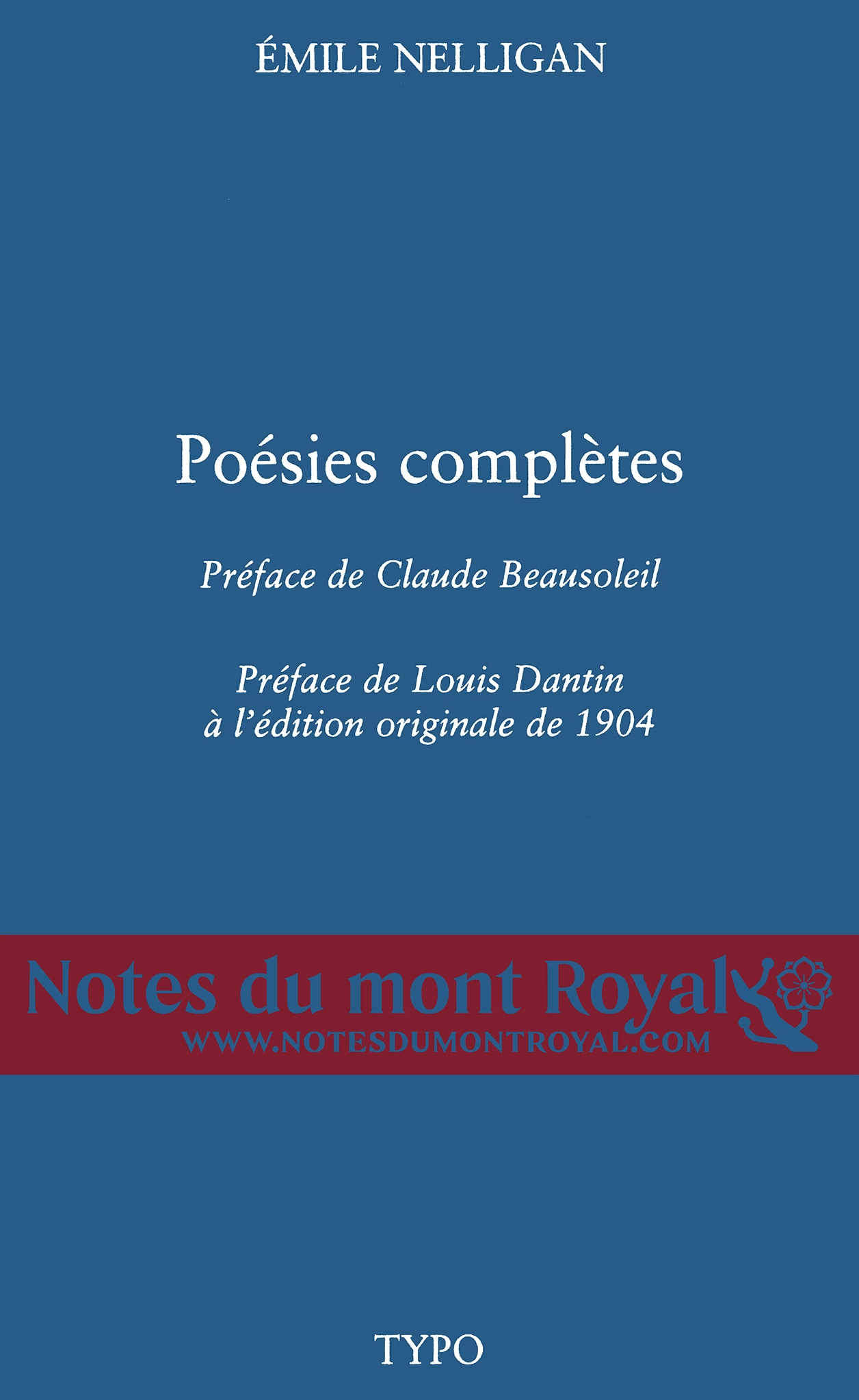
And it is not only in these verses, under the blow of some passing disappointment, that he experiences this disenchantment. It is throughout his Poésies complètes (Complete Poems), noble reveries of a cursed angel, who remained a stranger to the compromises that life imposes.
The Cursed Angel
In a famous photograph, this slender schoolboy with a pale face and disheveled hair fascinates with his large, liquid, infinite eyes—eyes that changed, that understood, that dreamed. He went about with ink-stained fingers, his frock coat in disarray, and amid all this, a proud air. “He’s an odd fellow,” some said; “a bit of a poser,” others found. But his pride was only a facade, poorly concealing an exasperated sensibility, now overflowing with enthusiasm, now darkened by a fierce and threatening melancholy:
“This is the reign of bitter laughter and of rage,
To know oneself a poet scorned and set apart,
To know oneself possessed of an uncomprehended heart
Grasped only by the moon and storms upon night’s stage!”Nelligan, Émile. Poésies complètes (Complete Poems), preface by Claude Beausoleil and Louis Dantin, Montreal: Typo, “Typo Poésie” collection, 1998.
The ambient incomprehension and the vigils spent scribbling feverish verses where “already, among dazzling strokes, madness showed its hideous claw”2The remark on the “hideous claw” is from Louis Dantin in his “Émile Nelligan et son Œuvre” (“Émile Nelligan and His Work”), published in seven installments in the newspaper Les Débats (1902) and soon becoming that mythical preface (1903) which revealed not only one of the finest poets of French Canada (Nelligan), but also one of its finest aesthetes (Dantin). eventually undermined his health before its time. He died twice: first, an intellectual death, or madness, at nineteen; then, a bodily death at fifty-seven.
Laughter and Sobs
There is no doubt that Nelligan suffered cruelly from this incomprehension. He who dreamed only of Paris claimed that his verses would one day fly there, only to return as a beautiful book. Such an ambition, youthful and vibrant, offered easy prey to malicious criticism. The most virulent attack came from Le Monde illustré, from the pen of some obscure journalist passing through Montreal, De Marchy or De Marchi, whose first name history has forgotten. With facile irony and petty narrow-mindedness, this censor mocked the adolescent’s originality, going so far as to suggest, in a tone of commiseration, that he write “a little thesis in simple prose” to prove his merit, adding perfidiously: “for we encourage young writers.”
Stung, Nelligan was not slow to respond at a memorable session of the École littéraire de Montréal on May 26, 1899. That evening, facing his detractors, those “men with morose brows / Who disdained [his] life and rejected [his] hand,” the young man rose. Mane flowing in the wind, his gaze aflame, he launched in one breath his stinging reply, “La romance du vin” (“The Romance of Wine”), which sent the room into delirium. It was at once his triumph and his farewell:
“The bells have sung; the fragrant evening sighs…
And while the wine in joyous torrents flows,
I am so gay, so gay, beneath the ringing skies,
Oh! so gay, that I fear I shall break into woes!”Nelligan, Émile. Poésies complètes (Complete Poems), preface by Claude Beausoleil and Louis Dantin, Montreal: Typo, “Typo Poésie” collection, 1998.
“Le vaisseau d’or” (“The Ship of Gold”)
Product of an improbable alchemy, Nelligan shows himself close to Poe through the macabre, to Heredia through his chiseled verse, to Nerval through his dreamlike nostalgias, but also to Rodenbach through the mists and to Chopin through a music of the soul. He cultivates with pride “his neuroses,” confiding: “I shall die mad… like Baudelaire.” Under the assault of some obsessive dream, some dominating idea, he rushes toward the absolute with “all the effort, all the blood of the soul,” which leads Louis Dantin to say: “Admitting that the man and the work are but a sketch, one must affirm that it is the sketch of a genius.”
This sketch of genius possesses the frightening lucidities of “what the Ancients called in Latin ’vates,’ the diviner, the seer, the prophet, the poet inspired by the gods”3Claude La Charité.. Roger Fournier evokes the “terrible moment” when the artist sees his end before living it. This premonition is embodied in “Le vaisseau d’or” (“The Ship of Gold”), his most emblematic sonnet. Nelligan paints the splendor of a triumphant vessel, “carved from solid gold,” sailing on unknown seas. But this glorious tableau is there only to be destroyed. In a tragic fall, the ship strikes the reef and sinks, leaving only rich wreckage. The reader then understands, with dread, that it is the poet himself, prophesying his own shipwreck:
“What has become of my heart, a deserted ship?
Alas! it has sunk into the abyss of dream…”Nelligan, Émile. Poésies complètes (Complete Poems), preface by Claude Beausoleil and Louis Dantin, Montreal: Typo, “Typo Poésie” collection, 1998.
Further Reading
On Poésies complètes (Complete Poems)
Quotations
“Ah! how the snow has snowed so deep!
My window is a garden of frost.
Ah! how the snow has snowed so deep!
What is the spasm of life to one so lost
In all the ennui I reap, I reap!…”Nelligan, Émile. Poésies complètes (Complete Poems), preface by Claude Beausoleil and Louis Dantin, Montreal: Typo, “Typo Poésie” collection, 1998.
Downloads
Audio Recordings
- Lecture de Poésies complètes par Yvon Jean. (Reading of Complete Poems by Yvon Jean) (Yvon Jean).
- Lecture partielle de Poésies complètes par Andrée-Ann Granger. (Partial Reading of Complete Poems by Andrée-Ann Granger) (LibriVox).
- Lecture partielle de Poésies complètes par Ange-Marie Mucel. (Partial Reading of Complete Poems by Ange-Marie Mucel) (YouTube).
- Lecture partielle de Poésies complètes par Ashley Candland. (Partial Reading of Complete Poems by Ashley Candland) (LibriVox).
- Lecture partielle de Poésies complètes par Borys de Pozenailles. (Partial Reading of Complete Poems by Borys de Pozenailles) (YouTube).
- Lecture partielle de Poésies complètes par Camille Panchaud-Lefebvre. (Partial Reading of Complete Poems by Camille Panchaud-Lefebvre) (YouTube).
- Lecture partielle de Poésies complètes par Carolyne Cannella. (Partial Reading of Complete Poems by Carolyne Cannella) (YouTube).
- Lecture partielle de Poésies complètes par Daniel Paquin. (Partial Reading of Complete Poems by Daniel Paquin) (YouTube).
- Lecture partielle de Poésies complètes par Diane Boudreau. (Partial Reading of Complete Poems by Diane Boudreau) (Littérature audio).
- Lecture partielle de Poésies complètes par Gilles-Claude Thériault. (Partial Reading of Complete Poems by Gilles-Claude Thériault) (YouTube).
- Lecture partielle de Poésies complètes par Lionel Mazari. (Partial Reading of Complete Poems by Lionel Mazari) (L’Impossible séjour).
- Lecture partielle de Poésies complètes par Michael Mansour. (Partial Reading of Complete Poems by Michael Mansour) (La Minute de poésie).
- Lecture partielle de Poésies complètes par ~Angelot. (Partial Reading of Complete Poems by ~Angelot) (Littérature audio).
- Lecture partielle de Poésies complètes par ~czandra. (Partial Reading of Complete Poems by ~czandra) (LibriVox).
- Lecture partielle de Poésies complètes par ~DanielDeronda. (Partial Reading of Complete Poems by ~DanielDeronda) (LibriVox).
- Lecture partielle de Poésies complètes par ~Mayah. (Partial Reading of Complete Poems by ~Mayah) (LibriVox).
- Luc Lacourcière à propos de Poésies complètes. (Luc Lacourcière on Complete Poems) (Radio-Canada).
Printed Works
- Édition de Poésies complètes (1903). (Edition of Complete Poems (1903)) (Bibliothèque et Archives nationales du Québec (BAnQ)).
- Édition de Poésies complètes (1903), copie. (Edition of Complete Poems (1903), copy) (Google Books).
- Édition de Poésies complètes (1903), copie 2. (Edition of Complete Poems (1903), copy 2) (Canadian Libraries).
- Édition de Poésies complètes (1997). (Edition of Complete Poems (1997)) (Bibliothèque et Archives nationales du Québec (BAnQ)).
- Édition de Poésies complètes (éd. électronique). (Edition of Complete Poems (electronic ed.)) (Wikisource).
- Édition partielle de Poésies complètes (1900). (Partial Edition of Complete Poems (1900)) (Google Books).
- Édition partielle de Poésies complètes (1900), copie. (Partial Edition of Complete Poems (1900), copy) (Canadian Libraries).
- Édition partielle de Poésies complètes (1900), copie 2. (Partial Edition of Complete Poems (1900), copy 2) (Bibliothèque et Archives nationales du Québec (BAnQ)).
- Édition partielle de Poésies complètes (1900), copie 3. (Partial Edition of Complete Poems (1900), copy 3) (Canadian Libraries).
- Édition partielle de Poésies complètes (1900), copie 4. (Partial Edition of Complete Poems (1900), copy 4) (Canadian Libraries).
- Édition partielle de Poésies complètes (1900), copie 5. (Partial Edition of Complete Poems (1900), copy 5) (Google Books).
- Édition partielle de Poésies complètes (1900 bis). (Partial Edition of Complete Poems (1900 bis)) (Canadian Libraries).
- Édition partielle de Poésies complètes (1900 bis), copie. (Partial Edition of Complete Poems (1900 bis), copy) (Google Books).
- Édition partielle de Poésies complètes (1900 bis), copie 2. (Partial Edition of Complete Poems (1900 bis), copy 2) (Canadian Libraries).
- Édition partielle de Poésies complètes (1983). (Partial Edition of Complete Poems (1983)) (Bibliothèque et Archives nationales du Québec (BAnQ)).
Bibliography
- Ab der Halden, Charles. “Émile Nelligan,” in Nouvelles études de littérature canadienne-française (New Studies in French-Canadian Literature), Paris: F. R. de Rudeval, 1907. (Google Books).
- Fournier, Roger. “Des moments émouvants sur la tombe d’Émile Nelligan” (“Moving Moments at the Tomb of Émile Nelligan”), in Émile Nelligan: dossier de presse 1918-1980 (Émile Nelligan: Press Dossier 1918-1980), Sherbrooke: Bibliothèque du Séminaire de Sherbrooke, 1981.
- Grisé, Yolande, Robidoux, Réjean and Wyczynski, Paul (eds.). Émile Nelligan (1879-1941): cinquante ans après sa mort (Émile Nelligan (1879-1941): Fifty Years After His Death). Proceedings of the colloquium organized by the Centre de recherche en civilisation canadienne-française de l’Université d’Ottawa, Montreal: Fides, 1993.
- Hayward, Annette. La Correspondance entre Louis Dantin et Germain Beaulieu: une grande amitié littéraire (1909-1941) (The Correspondence Between Louis Dantin and Germain Beaulieu: A Great Literary Friendship (1909-1941)), Quebec: Presses de l’Université Laval, 2023.
- La Charité, Claude. “Émile Nelligan et le mythe du génie précoce, mort fou” (“Émile Nelligan and the Myth of the Precocious Genius Who Died Mad”), in L’Invention de la littérature québécoise au 19e siècle (The Invention of Québécois Literature in the 19th Century), Quebec: Septentrion, 2021.
- Paul-Crouzet, Jeanne. Poésie au Canada: de nouveaux classiques français (Poetry in Canada: New French Classics), Paris: Didier, 1946.
- Robidoux, Réjean. Connaissance de Nelligan (Understanding Nelligan), Montreal: Fides, 1973.
- Samson, Jean-Noël and Charland, Roland-Marie (eds.). Émile Nelligan, Montreal: Fides, 1968.
- Vadeboncoeur, Pierre. “Émile Nelligan (1879-1941), poète” (“Émile Nelligan (1879-1941), Poet”), in En quelques traits (In a Few Strokes), Montreal: Fides, 1978.
- Wyczynski, Paul. Émile Nelligan: biographie (Émile Nelligan: A Biography), Quebec: Bibliothèque québécoise, 1999.