
The Gold of the Sikhs: Splendor and Universality of the Granth
Translated from French • English (anglais)
One of the holy ponds of India is the “lake of immortality” (Amrita Sara), at Amritsar1Rejected forms:
“Pool of immortality.”
“Pond of immortality.”
“Basin of immortality.”
“Basin of the draught of immortality.”
“Basin of nectar.”
“Lake of nectar.”
“Excellent ambrosia.”
Amrita Saras.
Umrita-sara.
Umritsar.
Umritsir.
Umretsir.
Amretsir.
Amritsir.
Umbritsir.
Amritsur.
Umritsur.
Umritzer.
Umbritzir.
Amretseyr., where the heart of the Sikh faith beats. Whoever goes there is swept along by a human crowd amid the scents of flowers and incense and arrives with it before a marvel: a golden temple enthroned, like a precious jewel, in the midst of the waters. One expects to be charmed and is dazzled instead. An indescribable throng of travelers, pilgrims, and curious onlookers of “all the races of India” jostles and calls out “in sonorous dialects that strike the ear like a blare of fanfares,” while children, running, make the circuit of the marble quays. This temple welcomes all without distinction of sex or religion. Inside, no idol. The sole object of veneration, set in the great hall beneath a canopy of brocade, is the Granth, originally compiled by Arjan, the fifth Guru, and his faithful scribe Bhai Gurdas. “Day and night without respite, as if to achieve a kind of perpetual adoration, granthi [officiants] sing, beneath these revered vaults, passages from the holy book, accompanying themselves on stringed instruments.”
Half a Millennium of Scattered Poetry
The Sikhs designate their sacred book as the Adi Granth (the First Book) or the Sri Guru Granth Sahib (the Venerated Master Book)2Rejected forms:
Sri Guru Granth Saheb.
Siri Guru Granth Sahid.
Shri Guru Grant Sahib.
Śrī Guru Grantha Sāhib., but more often still by the vague name of Granth (the Book)3Rejected forms:
Grantha.
Grant.
Grântah.
Grandth., just as Christians call theirs the Bible (the Books). Now, the Granth is a work entirely unique compared to the canons of other religions: a fascinating poetic anthology containing not only the hymns and canticles of its Gurus, but those of earlier mystics, such as Sheikh Fariduddin, known as Baba Farid, born around 1175. The Gurus themselves having lived between 1469 and 1708, here is half a millennium of scattered Indian poetry, whose uninterrupted recitation (akhand path) requires two days and two nights of granthi relaying one another without rest. That is why, on his deathbed, the tenth and last Guru, Gobind Singh, rather than naming a successor, decreed that this collection would henceforth be the eternal director of souls: “After my death, you must in all circumstances address yourselves to the Granth Sahib; it is he who shall be your Guru; whatever you ask of him, he will show you.”
The Common Kitchen of Brotherhood
The philosophy of the Granth is an education of love and benevolence, cast between the Hindu world and the Muslim world. From the first, it adopts devotion (bhakti) without idols or the yoke of castes. From the second — monotheism and the Sufi impulse without the sharia. By availing itself of high poetry, it gives the idea of what a life worth living can be, a true life; which raises it to the rank of a universal religion. Its prayer invariably closes with these wishes for all humanity: “May Thy will, O Lord, bring peace and happiness to each and to all, throughout the world.” Bhai Gurdas, already mentioned, explains:
“He [the Sikh] truly lives a life of sacrifice, the life of a slave of the Lord whom he loves. […] In his love, he forgets hunger and sleep. His hands are ceaselessly occupied in helping those in need and in comforting those who are cast down. […] Magnanimous, tolerant, and serene, he lives to serve humanity.”
Ladame, Paul-Alexis, « Les Sikhs » (The Sikhs), Cahiers d’études cathares, no. 147, Autumn 1995, pp. 3–38.
The Gurus preached an absolute equality, which finds its most concrete expression in the langar. This word designates the refectory adjoined to the temples and the communal meal served there, open to all. “The langar, launched by the first Guru, […] Nanak, was particularly original and radical in India where, for centuries, […] there were, and still are, prohibitions concerning the persons with whom one eats.” It is said that Emperor Akbar himself, the most tolerant of the Mughal sovereigns, submitted to this unconditional hospitality, sitting in the ranks of the humble to break bread with them4According to an unreliable tradition, this episode produced such an impression upon the monarch that he donated the land where the Sikhs would dig the “lake of immortality.”.
“Build the raft of contemplation; upon it you shall cross without obstruction,
And you shall strike neither the ocean nor the tide. […]
He who subdues his ego, strips himself of the ’self,’ and adorns himself in this fashion. […]
One parts no more if one truly unites with the Lord.
Then, the coming and going ceases, and one perceives the Lord everywhere.”5Sri Gourou Granth Sahib (Sri Guru Granth Sahib), vol. III, trans. from Punjabi, Hindi, Persian, and several Indian dialects by Jarnail Singh, p. 869.In highly symbolic language, this poem admirably summarizes the [Sikh] teaching. Man’s ego (haumai, “me-I”) […] is prisoner of material life and its faults, represented by the ocean and the tide. Because of them, […] he cannot reach the other shore, that of final emancipation (nirvanu) […]. Man must therefore purify his spiritual essence (manu), free it from the gangue of the “me-I,” and thereby render himself pleasing to God.“
Matringe, Denis, Les Sikhs : histoire et tradition des « Lions du Panjab » (The Sikhs: History and Tradition of the ”Lions of the Punjab“), Paris: Albin Michel, ”Planète Inde“ series, 2008.
An Earthly Jerusalem
Evening falls over the Punjab, and the golden temple is haloed with garlands of oil lamps ”whose reflections in the water make it shimmer with the scintillations of a treasure“ (Mircea Eliade). The contemplator then muses that this place is far more than it appears. It is the vision of a city ever ”brilliant […] nobly presenting to the gaze […] its thousands of resplendent domes, upon which the light […] falls and rebounds in dazzling vapor“ (Lamartine). It is the promise of a city that reconciles man with his fellow, as with himself, and from which the original Jerusalem seems to me to drift further with each passing day:
”For a Christian, the temple of Amritsar seems to prefigure the heavenly Jerusalem, a city whose gates, the Book of Revelation says, shall never be closed, so as to welcome all peoples6Et ambulabunt gentes in lumine ejus, et reges terræ afferent gloriam suam et honorem in illam. Et portæ ejus non claudentur per diem; nox enim non erit illic (The nations shall walk in its light, and the kings of the earth shall bring their glory into it. Day after day, the gates shall never be closed; for there shall be no night there). Rev. 21:24–25 (La Bible : traduction officielle liturgique (The Bible: Official Liturgical Translation)). before the throne of God and of the Lamb. Indeed, there is in this place the herald of a reconciled humanity, all the more moving when one knows the painful history of the Punjab and of Sikhism.“
Vagneux, Yann, « Le Temple d’or » (The Golden Temple), La Croix, January 12, 2024.
Further Reading
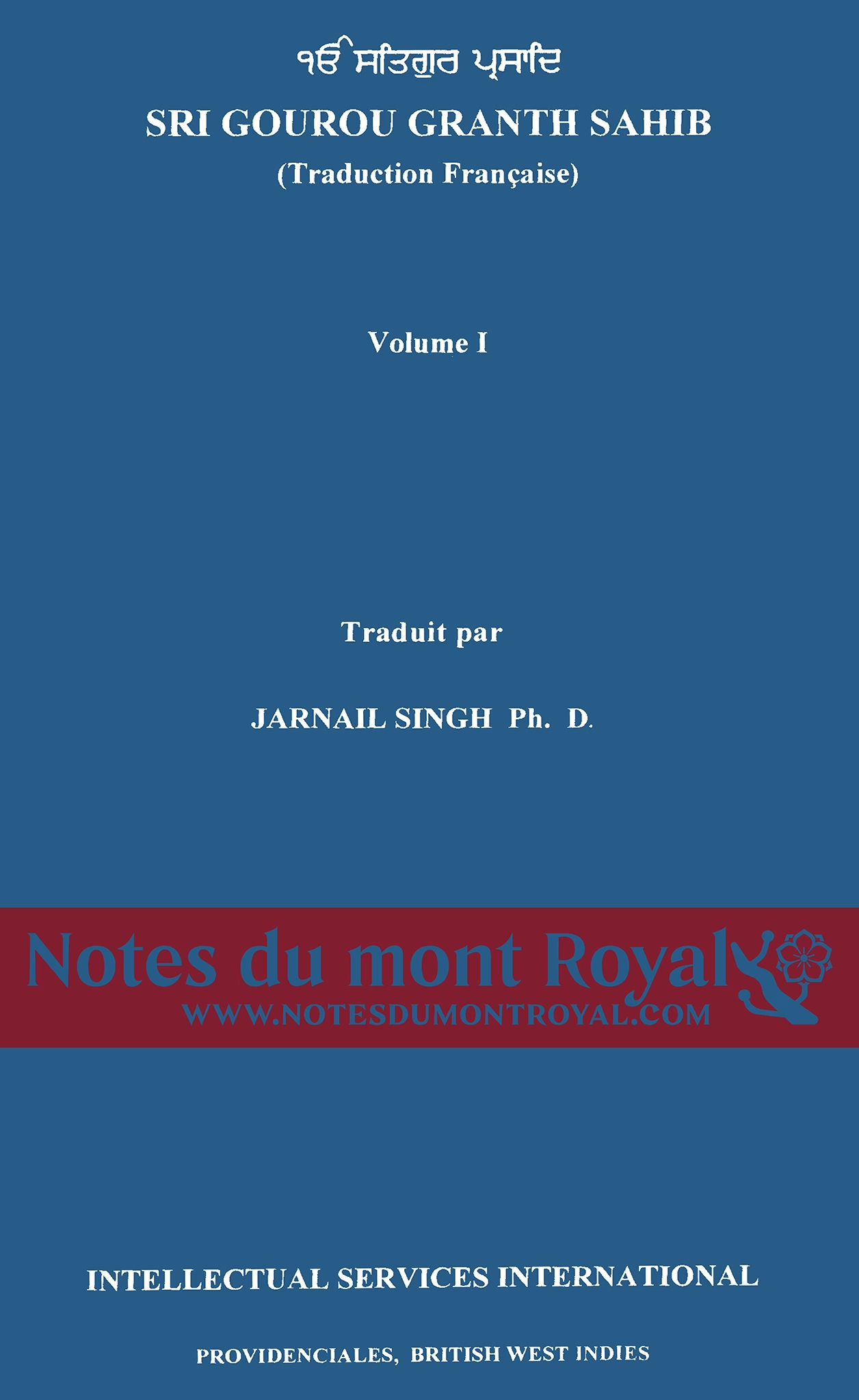
Around Sri Gourou Granth Sahib (Sri Guru Granth Sahib), vol. I
Quotations
”At the age of ten, one is a child,
Youth shows itself at twenty;
And at thirty, one takes pride in one’s beauty.
One blossoms at forty,
At fifty, one’s footing is unsure,
And at sixty, old age overtakes the man.
At seventy, the intellect weakens,
At eighty, one is unable to work.
At ninety, one is bedridden forever,
And strength fails us utterly.
Nanak, I have searched everywhere,
I have understood that the world is but a castle of smoke.“Sri Gourou Granth Sahib (Sri Guru Granth Sahib), vol. I, trans. from Punjabi, Hindi, Persian, and several Indian dialects by Jarnail Singh, Providenciales: Intellectual Services International, 1996.
Downloads
Sound Recordings
- Denis Matringe à propos des sikhs (Denis Matringe on the Sikhs). (France Culture).
Printed Works
- Traduction de Sri Gourou Granth Sahib, t. I par Jarnail Singh (1996) (Translation of Sri Guru Granth Sahib, vol. I by Jarnail Singh (1996)). (Sikh Book Club).
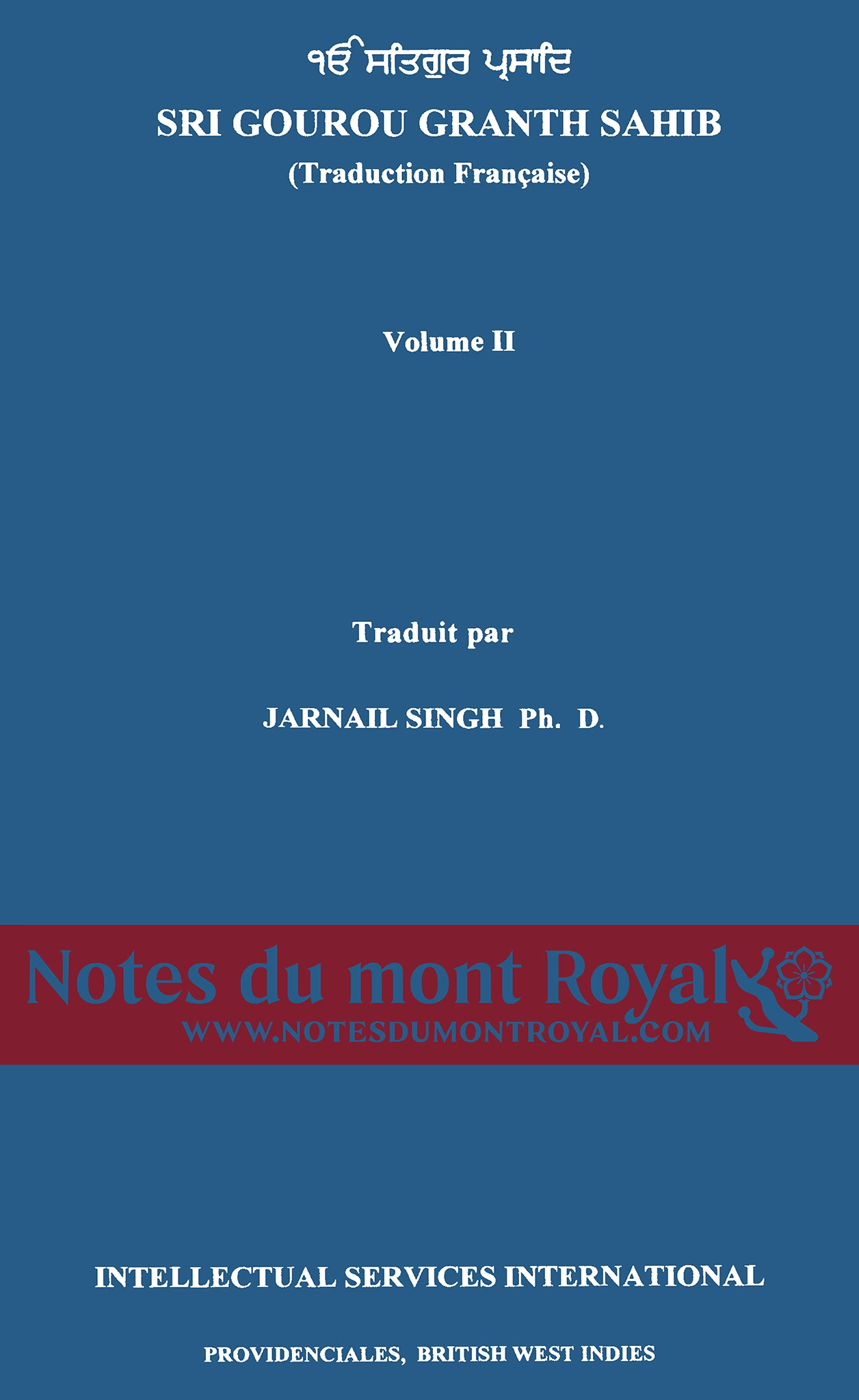
Around Sri Gourou Granth Sahib (Sri Guru Granth Sahib), vol. II
Quotations
”The rich take pride in their riches;
The landowners take pride in their lands;
The king takes pride in his territory;
But for the devotee, it is His support that is everything.
If one relies on the True One, the Lord,
The Master helps him with all His power, and he knows no defeat.
When one abandons every other support and seeks the refuge of the Lord,
[…] the Lord comes to dwell in our mind.“Sri Gourou Granth Sahib (Sri Guru Granth Sahib), vol. II, trans. from Punjabi, Hindi, Persian, and several Indian dialects by Jarnail Singh, Providenciales: Intellectual Services International, 1996.
Downloads
Sound Recordings
- Denis Matringe à propos des sikhs (Denis Matringe on the Sikhs). (France Culture).
Printed Works
- Traduction de Sri Gourou Granth Sahib, t. II par Jarnail Singh (1996) (Translation of Sri Guru Granth Sahib, vol. II by Jarnail Singh (1996)). (Sikh Book Club).
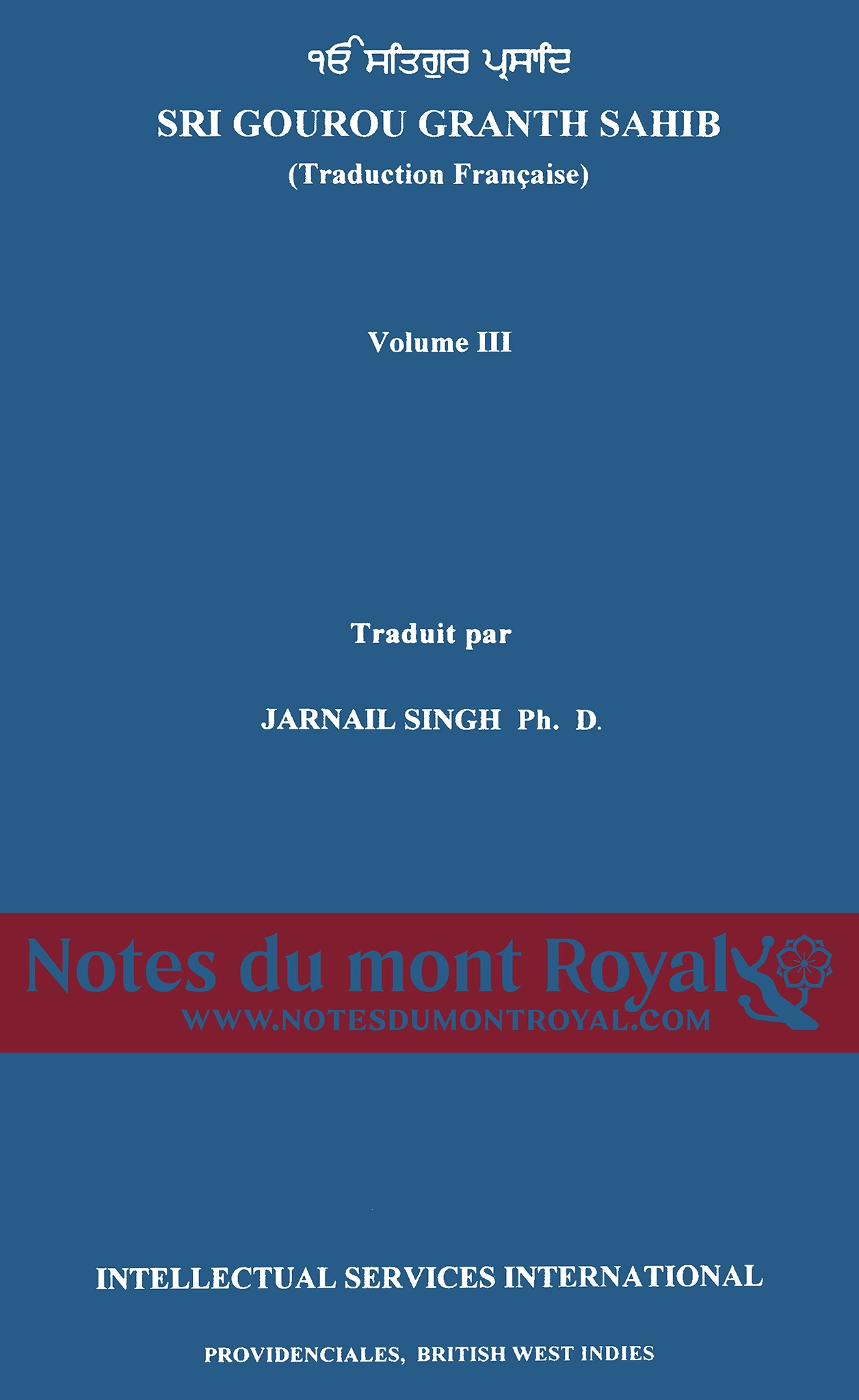
Around Sri Gourou Granth Sahib (Sri Guru Granth Sahib), vol. III
Quotations
”Death reigns in the world; truly it is like a castle of sand.
This castle vanishes suddenly, like paper in the rain.
O my wavering mind, reflect well upon the truth!
Siddhas, yogis, adepts, householders — in the end, all depart from here.
Ephemeral as the dream of the night is the world,
All that we see shall disappear one day,
Therefore, O ignorant one, why do you cling to the mirage?
Where are your brothers? Where are your friends? Look well!
Some have gone, others shall go, each in turn. […]
Nanak is Thy servant, O Lord, save my honor!“Sri Gourou Granth Sahib (Sri Guru Granth Sahib), vol. III, trans. from Punjabi, Hindi, Persian, and several Indian dialects by Jarnail Singh, Providenciales: Intellectual Services International, 1996.
Downloads
Sound Recordings
- Denis Matringe à propos des sikhs (Denis Matringe on the Sikhs). (France Culture).
Printed Works
- Traduction de Sri Gourou Granth Sahib, t. III par Jarnail Singh (1996) (Translation of Sri Guru Granth Sahib, vol. III by Jarnail Singh (1996)). (Sikh Book Club).
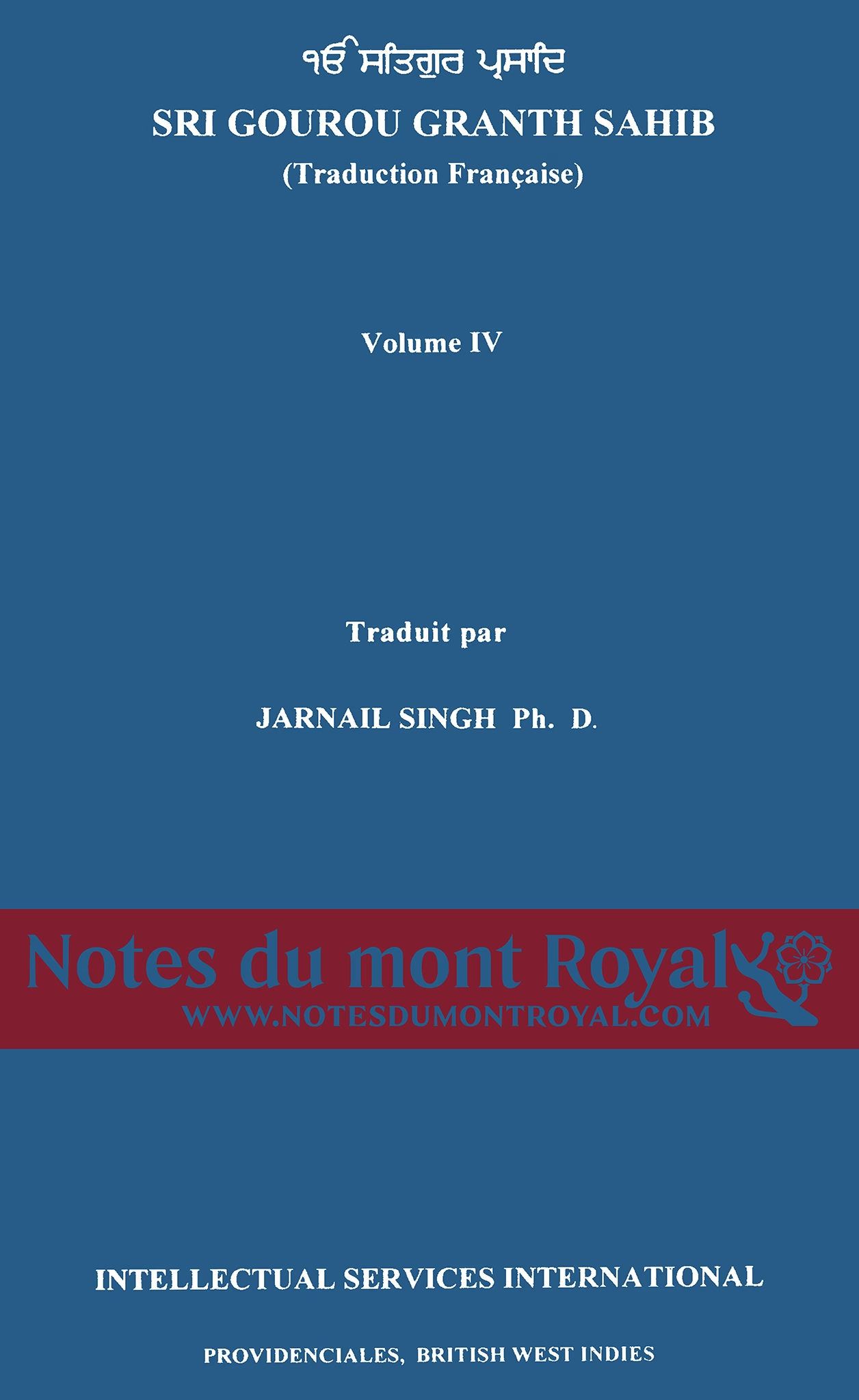
Around Sri Gourou Granth Sahib (Sri Guru Granth Sahib), vol. IV
Quotations
”One laments and one complains; it is the daily routine,
One remembers one’s (deceased) relations because of what they brought us.
But if one consciously detaches oneself from the world,
One dies no more, one is born no more, and one suffers no sorrow.
All conflict arises from the entanglement of Maya [Illusion],
Rare is the person who relies on the Name [of the Lord].
Maya with three qualities7This refers to what Hindu cosmology calls the triguna or the three qualities of Maya: goodness, passion, darkness. “These qualities exist in God as apparent rather than real phenomena, for [we] are told to the point of satiety: ’God has no qualities,’ He has no guna [attributes], since nothing limits Him, since He cannot be in one way rather than another, but is in every way, ’absolutely’” (Alfred Roussel). controls the whole world,
Whoever clings to it suffers sorrow.“Sri Gourou Granth Sahib (Sri Guru Granth Sahib), vol. IV, trans. from Punjabi, Hindi, Persian, and several Indian dialects by Jarnail Singh, Providenciales: Intellectual Services International, 1996.
Downloads
Sound Recordings
- Denis Matringe à propos des sikhs (Denis Matringe on the Sikhs). (France Culture).
Printed Works
- Traduction de Sri Gourou Granth Sahib, t. IV par Jarnail Singh (1996) (Translation of Sri Guru Granth Sahib, vol. IV by Jarnail Singh (1996)). (Sikh Book Club).
Bibliography
- Basil, Priya, Be my guest : cuisine, hospitalité et générosité (Be My Guest: Cooking, Hospitality, and Generosity), trans. from English by Carole Hanna, Paris: Delcourt, 2020.
- Eliade, Mircea, L’Inde (India), trans. from Romanian by Alain Paruit, Paris: l’Herne, ”Méandres“ series, 1988.
- Harbans Singh and Delahoutre, Michel, Le Sikhisme : anthologie de la poésie religieuse sikhe. Le « Guru Granth » • Bhâî Vîr Singh (Sikhism: Anthology of Sikh Religious Poetry. The ”Guru Granth“ • Bhai Vir Singh), pref. by Olivier Lacombe, Louvain-la-Neuve: Centre d’histoire des religions, ”Homo religiosus“ series, 1985.
- Ladame, Paul-Alexis, « Les Sikhs » (The Sikhs), Cahiers d’études cathares, no. 147, Autumn 1995, pp. 3–38.
- Matringe, Denis, Les Sikhs : histoire et tradition des « Lions du Panjab » (The Sikhs: History and Tradition of the ”Lions of the Punjab“), Paris: Albin Michel, ”Planète Inde“ series, 2008.
- Réville, Albert, « Les Sikhs » (The Sikhs), Revue politique et littéraire (Revue bleue), July to December 1883. (Google Books).
- Robie, Jean, « Amritsir [Amritsar] et le Temple d’or » (Amritsar and the Golden Temple), Bulletin de la Classe des lettres et des sciences morales et politiques et de la Classe des beaux-arts, Brussels: Académie royale de Belgique, 1900, pp. 801–809. (Google Books).
- Singh Kalsi, Sewa, Le Sikhisme : le sabre à double tranchant et l’unicité de Dieu (Sikhism: The Double-Edged Sword and the Oneness of God), trans. from English, adaptation and updating by Alain Sainte-Marie, Arles: Actes Sud, ”Le souffle de l’esprit“ series, 2019.
- Vagneux, Yann, « Le Temple d’or » (The Golden Temple), La Croix, January 12, 2024.