Lament of a Warrior’s Wife: From Đặng Trần Côn to Hoàng Xuân Nhị
Translated from French • English (anglais)
“No, she has forgotten everything, thinking only of her husband’s departure. Another god [than the god of war] inspires her, dictates her touching farewells and bathes her eyes in tears. So true is it that the torments of the briefest absence exceed the strength of lovers!”
Catullus. Traduction complète des poésies de Catulle, suivie des poésies de Gallus et de la Veillée des fêtes de Vénus (Complete Translation of the Poetry of Catullus, Followed by the Poetry of Gallus and the Vigil of the Feast of Venus), trans. from the Latin by François Noël. Paris: Rémont, 1806.
These verses by Catullus could just as well have been written in the Vietnam of the 1740s. It was during this troubled period, marked by military conscription, that the Lament of a Warrior’s Wife (Chinh phụ ngâm)1Rejected forms:
Plaintes d’une femme dont le mari est parti pour la guerre (Laments of a Woman Whose Husband Has Gone to War).
Complainte d’une femme de guerrier (Lament of a Warrior’s Wife).
Complainte de la femme du guerrier (Lament of the Warrior’s Wife).
Complainte de la femme d’un guerrier (Lament of a Warrior’s Wife).
Plaintes de la femme du guerrier (Laments of the Warrior’s Wife).
Complainte de la femme d’un soldat (Lament of a Soldier’s Wife).
Plainte d’une femme de soldat (Lament of a Soldier’s Wife).
Le Chant de la femme d’un guerrier (The Song of a Warrior’s Wife).
Chant de la femme du guerrier (Song of the Warrior’s Wife).
Chant de la femme du combattant (Song of the Combatant’s Wife).
Romance de la femme du combattant (Romance of the Combatant’s Wife).
Plaintes d’une chinh-phou, femme dont le mari part pour la guerre (Laments of a Chinh-Phou, a Woman Whose Husband Departs for War).
Les Plaintes d’une chinh-phu (The Laments of a Chinh-Phu).
Scansion d’une femme de guerre (Scansion of a Woman of War).
Scansion d’une femme dont le mari est à la guerre (Scansion of a Woman Whose Husband Is at War).
La Complainte de l’épouse du guerrier (The Lament of the Warrior’s Wife).
La Complainte de l’épouse du combattant (The Lament of the Combatant’s Wife).
Femme de guerrier (élégie) (Wife of a Warrior [Elegy]).
Chinh phụ (ngâm khúc). was composed. Amid the rolling of drums rise the tears of a young Vietnamese woman, whose husband, gone to the front, is slow in returning—and never returns. “All the sadness, all the revolt, […] all the anguish of waiting is expressed there with incomparable refinement.” It is an intimate elegy, not a pamphlet. And yet it strikes such a note of helpless despair, such a sincere yearning for the gentleness and simple joys of love, that it awakens an instinctive aversion to war. Legend has it, indeed, that some soldiers, hearing it sung at twilight in the camps, would desert. Listen to the warrior’s wife:
“Many are those who depart, few are those who return:
On the fields of carnage, the soldier’s adventurous life
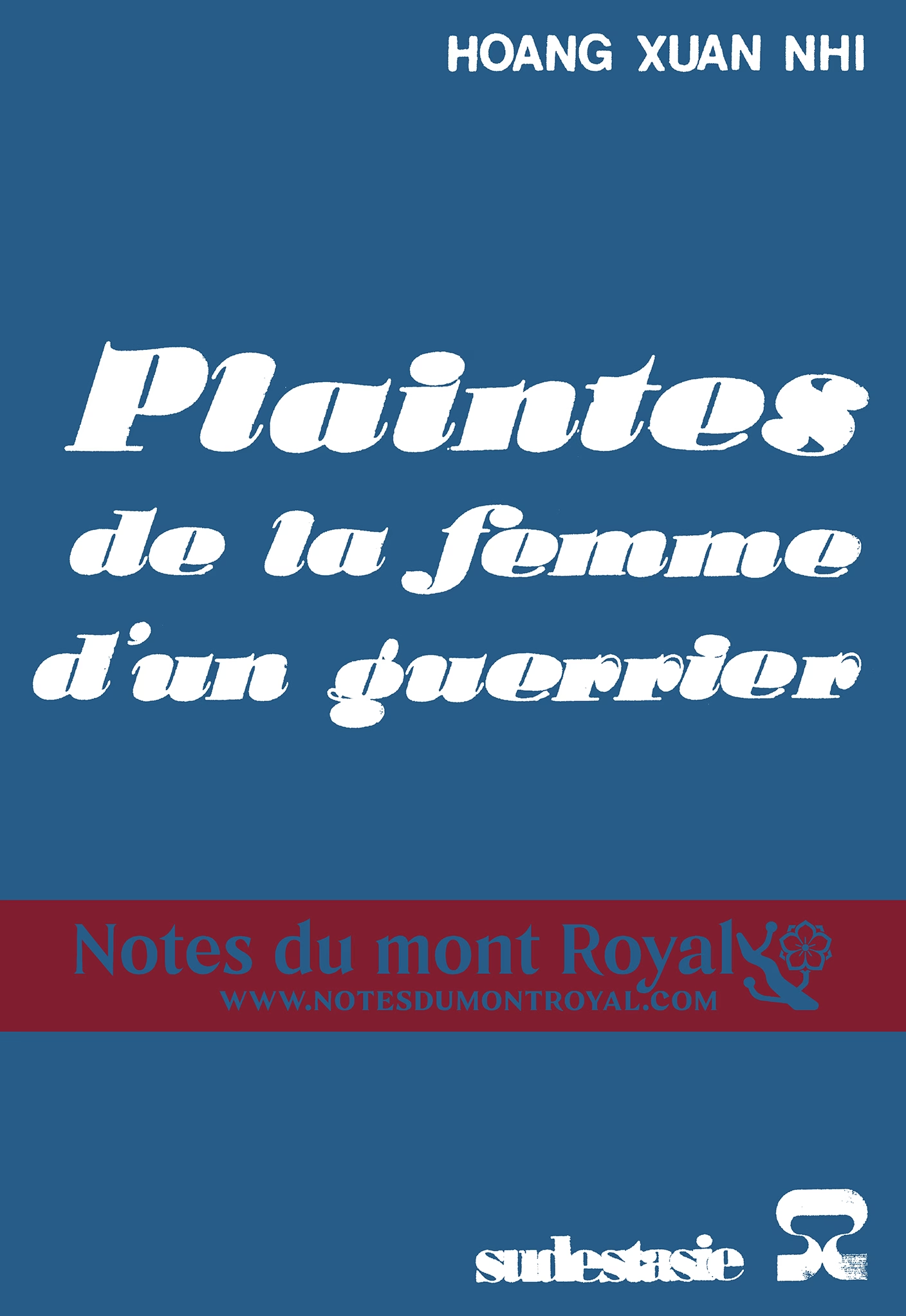
Is all too like the color of leaves!”Đặng, Trần Côn and Đoàn, Thị Điểm. Plaintes d’une chinh-phou, femme dont le mari part pour la guerre, et autres poèmes (Laments of a Chinh-Phou, a Woman Whose Husband Departs for War, and Other Poems), trans. from the Vietnamese by Hoàng Xuân Nhị. Paris: Stock, 1943; reissued as Plaintes de la femme d’un guerrier (Lament of a Warrior’s Wife), Paris: Sudestasie, 1987.
This lament has been borne down to us by three exceptional figures, brought together across the centuries: an original poet, a translator of genius, and an intrepid francophone interpreter.
Đặng Trần Côn: The Original Poet
Of Đặng Trần Côn, the annals have preserved the image of an absolute man of letters. When a curfew descended upon the capital Thăng Long (present-day Hanoi), the author dug a clandestine cellar in order to keep secret vigil with his books. Who knows whether the humble lamp of his studious nights is not the very one immortalized in these stanzas:
“[…] perhaps the lamp understands me…
Or does the lamp not understand me?
Then I shall suffer alone?”Đặng, Trần Côn and Đoàn, Thị Điểm. Plaintes d’une chinh-phou, femme dont le mari part pour la guerre, et autres poèmes (Laments of a Chinh-Phou, a Woman Whose Husband Departs for War, and Other Poems), trans. from the Vietnamese by Hoàng Xuân Nhị. Paris: Stock, 1943; reissued as Plaintes de la femme d’un guerrier (Lament of a Warrior’s Wife), Paris: Sudestasie, 1987.
The wounds of a country then torn between the lords of the North and the South lent his poem, written in classical Chinese, a terrible aptness. It was read and admired as far as China. And some, alarmed by the brilliance of such talent, exclaimed: “All his intelligence is manifest in this long poem. The author will live three years more at most.” A grim and truthful prophecy: Đặng Trần Côn died three years later, driven, it is whispered, to suicide.
Đoàn Thị Điểm: The Translator of Genius
The work, despite its merit, might never have spread among the people, had it not been for its translation into the national language by Đoàn Thị Điểm, called Hồng Hà (“Rosy Reflections” or “Rosy Cloud”)2Of Đoàn Thị Điểm we have no information other than that supplied by the grief of her husband, who mourned her in a funeral oration:
“Plying her brush to depict landscapes,
She gave voice to feelings of great depth […]
Capable of moving even the Immortals; […]
Alas! She had no settled abode; […]
Wed only past her thirtieth year,
She left this earth past her fortieth; […]
She departed without forewarning her aged mother; […]
Is fate not strange?
Is Heaven, then, unjust?…”. Her resolutely feminine version—inspired, if I may say, by the storms of the soul—rose to the rank of original creation, sometimes even eclipsing Đặng Trần Côn’s source text, admirable as it already was! “This shows to what degree the poetess […] possessed all the secrets both of the Chinese language and of her native tongue.” Never before had the song thất lục bát meter (“double seven, six, eight”), so well suited to noble melancholy, been employed with such art: “Each word is a tear, each verse a sob […] from the heart. And it is a heart in flames, a heart in tempest, […] the pretty little heart of a woman wounded unto death by the diabolical arrow of love—and of the most serious love, conjugal love.”3Thus speaks Trần Văn Tùng in his remarkable collection Poésies d’Extrême-Orient (Poems of the Far East).
Hoàng Xuân Nhị: The Intrepid Francophone Interpreter
A few words, finally, on Hoàng Xuân Nhị. Present in Paris at the first thunder of the Second World War, he sought in the poetry of his ancestors a universal message to address to a Europe in flames. His Journal describes the enthusiasm that one day made him walk—or rather fly—across the capital, declaiming aloud like a man possessed, like a madman. Parisians turned around with amused or pitying looks: “Poor things!” he thought, “they would have been transported with delight and would have forgotten the infinite sadness of the war, had they but a drop of my great happiness!”
Why did he settle his choice upon the Lament of a Warrior’s Wife? Because it was inscribed “in [his] very blood” from the cradle: orphaned early, he had found in “the infinitely precious tears of that noble and so pitiable woman, that Mariana Alcoforado of Far Asia” a maternal affection. To translate her, to interpret her, was to fulfill a humanist dream, set down in his Journal on December 25, 1940: “An original synthesis—above all, a living one—of two humanities, of two worlds: of the East and the West, that is what I have resolved to be, that is what I strive to be, that is what I am in the process of being.” A pledge magnificently kept! Witness the reception accorded his translation, which Robert Brasillach4I must note that Robert Brasillach’s calamitous commitments under the Occupation would come to contradict, with violence, the humanist ideal he applauds here. hailed in these laudatory terms: “Mr. Hoàng Xuân Nhị […] has been able to bring his country closer to us […]. Man is one, from one end of the planet to the other, and, in reading the meditations on the flight of days or on war, on the pleasure of loving, on death, I thought now of Catullus, now of Homer, now of Corneille, of Mallarmé, of Valéry. It is fine to be reminded of these names, fine to know how to unite two cultures so dissimilar in appearance, and, without seeking any impure mixture, to help them understand each other.”
Further Reading
On Lament of a Warrior’s Wife
Quotations
“信來人未來
楊花零落委蒼苔
蒼苔蒼苔又蒼苔
一步閒庭百感催”Chinh phụ ngâm on Wikisource tiếng Việt, [online], accessed May 7, 2026.
“Tin gửi đi (var. thường lại) người không thấy lại,
Hoa dương tàn đã trải rêu xanh.
Rêu xanh mấy lớp chung quanh,
Dạo sân (var. Sân đi) một bước trăm tình ngẩn ngơ!”Chinh phụ ngâm (Đoàn Thị Điểm dịch) on Wikisource tiếng Việt, [online], accessed May 7, 2026.
“The tidings depart, the man never returns!
The willow flowers have, more than once, strewn the verdant moss.
The moss, more than once, has fed upon those fallen flowers;
Each step upon the flagstones awakens countless sorrows!”Đặng, Trần Côn and Đoàn, Thị Điểm. Plaintes d’une chinh-phou, femme dont le mari part pour la guerre, et autres poèmes (Laments of a Chinh-Phou, a Woman Whose Husband Departs for War, and Other Poems), trans. from the Vietnamese by Hoàng Xuân Nhị. Paris: Stock, 1943; reissued as Plaintes de la femme d’un guerrier (Lament of a Warrior’s Wife), Paris: Sudestasie, 1987.
“The messages have arrived, but you have not arrived.
The poplar’s flowers wither and fall upon the green moss,
The green moss, the green moss, and again the green moss!
At every step, in the deserted courtyard, a hundred thoughts assail me.”Đặng, Trần Côn. “La Complainte de l’épouse du guerrier” (The Lament of the Warrior’s Wife), trans. from the Chinese by Maurice Durand. Bulletin de la Société des études indochinoises (Bulletin of the Society for Indochinese Studies), Saigon: Société des études indochinoises, vol. XXVIII, no. 2, 1953.
“Often I have written him; he does not return.
The aspen flowers strew the green moss.
All around, what layers of green moss!
Each step I take upon this soft carpet
Recalls one by one troubling memories.”Đặng, Trần Côn and Đoàn, Thị Điểm. “Chinh phụ (ngâm khúc) = Femme de guerrier (élégie)” (Wife of a Warrior [Elegy]), trans. from the Vietnamese by Tuần Lý (Huỳnh Khắc Dụng). Bulletin de la Société des études indochinoises (Bulletin of the Society for Indochinese Studies), Saigon: Société des études indochinoises, vol. XXX, no. 3, 1955; reissued Saigon: Bộ Quốc gia Giáo dục, 1960.
“Tidings often reach me, but the man never returns;
The poplar flowers, all withered (faded), have strewn the verdant moss.
The moss spreads all around a thick greenish carpet.
Each step I take awakens countless memories sweet and painful.”Đặng, Trần Côn and Đoàn, Thị Điểm. Chinh phụ ngâm = Complainte de la femme d’un guerrier (Lament of a Warrior’s Wife), trans. from the Vietnamese by Bùi Văn Lăng. Hanoi: Éditions Alexandre de Rhodes, 1943.
“The tidings depart, the man does not return.
The withered poplar flowers strew the moss.
The moss spreads all around its greenish carpet.
Each step in the courtyard stirs a thousand vague feelings.”Đặng, Trần Côn and Đoàn, Thị Điểm. Chant de la femme du combattant (Song of the Combatant’s Wife), trans. from the Vietnamese by Lê Thành Khôi. Paris: Gallimard, 1967.
“You have often written to me, but you have not returned,
The withered poplar flowers have formed a green mossy carpet.
Upon this green moss, I have wandered round and round,
And every step in the courtyard rekindles in me a hundred desolate feelings.”Đặng, Trần Côn and Đoàn, Thị Điểm. Complainte d’une femme de guerrier (Lament of a Warrior’s Wife), trans. from the Vietnamese by Đông Phong [Nguyễn Tấn Hưng]. Montreuil-sous-Bois: J. Ouaknine, 2009.
“The messages often arrive, the man does not return.
The withered poplar flowers strew the green moss,
The moss spreads all around greenish layers.
Each step in the courtyard awakens a thousand vague troubling feelings.”Đặng, Trần Côn and Đoàn, Thị Điểm. Tâm ca tình nghĩa vợ chồng: Chinh phụ ngâm = Chant de la femme du guerrier (Song of the Warrior’s Wife), trans. from the Vietnamese by Đặng Quốc Cơ. Cachan: Q. C. Dang, 2012.
“Often I have received tidings,
But never seen my husband again!
In our courtyard, the dry poplar flowers
Have covered the thick carpet of moss;
At every one of my pensive steps,
A thousand thoughts have come to assail me!”Đặng, Trần Côn and Đoàn, Thị Điểm. “Plaintes d’une femme dont le mari est parti pour la guerre = Chinh phụ ngâm” (Laments of a Woman Whose Husband Has Gone to War), trans. from the Vietnamese by Lê Văn Chất, Hoàng Xuân Nhị, Hữu Ngọc [Nguyễn Hữu Ngọc], Nguyễn Khắc Viện, Phạm Huy Thông, Tảo Trang [Vũ Tuân Sán] and Vũ Quý Vỹ, with the collaboration of Françoise Corrèze. Anthologie de la littérature vietnamienne. Tome II, 18e siècle, première moitié du 19e siècle (Anthology of Vietnamese Literature. Volume II, 18th Century, First Half of the 19th Century). Hanoi: Éditions en langues étrangères, 1972; reissued Paris-Montréal: L’Harmattan, 2000.
“Often I have received tidings,
Never have I seen my husband again!
In the courtyard, the dry poplar flowers
Have covered the thick carpet of moss.
At every one of my pensive steps,
A thousand thoughts have come to assail me!”Đặng, Trần Côn and Đoàn, Thị Điểm. “Complainte de la femme d’un guerrier” (Lament of a Warrior’s Wife), trans. from the Vietnamese by Lê Văn Chất. Anthologie de la poésie vietnamienne (Anthology of Vietnamese Poetry). Paris: Les Éditeurs français réunis, 1969.
“(My) letters have often reached (you), but you are not seen returning.
Poplar flowers, withered, are already strewn upon the green moss.
(Upon) the green moss which, in many layers, (grows) all around,
At every step I take, a host of sad feelings (besiege my heart).”Đặng, Trần Côn and Đoàn, Thị Điểm. “Une élégie annamite: Chinh phụ ngâm = Le Chant de la femme d’un guerrier” (An Annamite Elegy: The Song of a Warrior’s Wife), trans. from the Vietnamese by Dương Quảng Hàm. Bulletin général de l’Instruction publique de l’Indochine (General Bulletin of Public Instruction in Indochina), Hanoi, December 1940 and November 1942.
“The letters arrive, but you, my husband, my love, you do not arrive!
Weary of awaiting you, the flowers swoon, and their petals strew the ground and cover the moss,
Each step in the courtyard echoes like a sob in my wounded heart!”Trần, Văn Tùng. Poésies d’Extrême-Orient (Poems of the Far East). Paris: B. Grasset, 1945.
Downloads
Printed Works
- Translation of Plaintes de la femme d’un guerrier (Lament of a Warrior’s Wife) by Đặng Quốc Cơ (electronic ed.). (Yoto Yotov).
- Partial translation of Plaintes de la femme d’un guerrier (Lament of a Warrior’s Wife) by Dương Quảng Hàm (1940-1942), part 1. (Bibliothèque nationale de France (BnF)).
- Partial translation of Plaintes de la femme d’un guerrier (Lament of a Warrior’s Wife) by Dương Quảng Hàm (1940-1942), part 2. (Bibliothèque nationale de France (BnF)).
- Edition and translation of Plaintes de la femme d’un guerrier (Lament of a Warrior’s Wife) by Bùi Văn Lăng (1943). (National Library of Vietnam).
- Edition and translation of Plaintes de la femme d’un guerrier (Lament of a Warrior’s Wife) by Bùi Văn Lăng (1943), copy. (Vietnamica).
- Edition and translation of Plaintes de la femme d’un guerrier (Lament of a Warrior’s Wife) by Maurice Durand (1953). (Vietnamica).
- Edition and translation of Plaintes de la femme d’un guerrier (Lament of a Warrior’s Wife) by Tuần Lý (Huỳnh Khắc Dụng) (1955). (Vietnamica).
- Edition and translation of Plaintes de la femme d’un guerrier (Lament of a Warrior’s Wife) by Tuần Lý (Huỳnh Khắc Dụng) (electronic ed.). (Giao Cảm).
- Partial edition of Plaintes de la femme d’un guerrier (Lament of a Warrior’s Wife) by Georges Cordier (1932). (National Library of Vietnam).
- Partial edition of Plaintes de la femme d’un guerrier (Lament of a Warrior’s Wife) by Georges Cordier (1932), copy. (Vietnamica).
Bibliography
- Anonymous. “La Femme annamite à travers la littérature d’Annam: essai littéraire” (The Annamite Woman Through the Literature of Annam: A Literary Essay) [serial]. La Patrie annamite (The Annamite Homeland), Hanoi, August 4 to October 13, 1941. (Bibliothèque nationale de France (BnF)).
- Baruch, Jacques. Essai sur la littérature du Viêt-nam (Essay on the Literature of Vietnam). Brussels: Éditions Thanh-Long, “Études orientales” series, 1963.
- Brasillach, Robert. “Sagesses de l’Orient. Lanza del Vasto: Pèlerinage aux sources (Denoël) • Hoang Xuan Nhi: Plaintes d’une chinh-phou (Stock)” (Wisdoms of the East. Lanza del Vasto: Pilgrimage to the Sources [Denoël] • Hoang Xuan Nhi: Laments of a Chinh-Phou [Stock]). Le Petit Parisien, Paris, December 29, 1943. (Bibliothèque nationale de France (BnF)).
- Durand, Maurice and Nguyễn, Trần Huân. Introduction à la littérature vietnamienne (Introduction to Vietnamese Literature). Paris: G.-P. Maisonneuve et Larose, “Unesco d’initiations aux littératures orientales” series, 1969.
- Hoàng, Xuân Nhị. Thuy-Kiêou: voix nouvelle sur un thème éternel de souffrance, suivi de Fragments du journal de l’auteur (Thuy-Kiêou: A New Voice on an Eternal Theme of Suffering, Followed by Fragments from the Author’s Journal). Paris: Mercure de France, 1942.
- Hữu, Ngọc and Corrèze, Françoise. Fleurs de pamplemoussier: femmes et poésie au Vietnam (Pomelo Blossoms: Women and Poetry in Vietnam). Paris: L’Harmattan, 1984.
- Lê, Thành Khôi. Histoire et anthologie de la littérature viêtnamienne des origines à nos jours (History and Anthology of Vietnamese Literature from Its Origins to the Present). Paris: Les Indes savantes, 2008.
- Trần, Cửu Chấn. Les Grandes Poétesses du Viêt-nam: études littéraires (The Great Poetesses of Vietnam: Literary Studies). Saigon: Imprimerie de l’Union Nguyễn-Văn-Của, 1950. (National Library of Vietnam).