Akutagawa Ryūnosuke, or the Beauty of the Ultimate Gaze
Translated from French • English (anglais)
“A vague uneasiness.” (Bon’yari shita fuan.) These words, traced in haste by Akutagawa Ryūnosuke1Rejected forms:
Acutagawa Ryunosuche.
Akutagawa Riunoské.
Akoutagawa Ryunosouké.
Akoutagaoua Ryounosouké.
Akoutagava Ryounosouke. before absorbing the poison at dawn on 24 July 1927, are as the key to all his writings. He was thirty-five years old. He left behind him some hundred and fifty short stories in which “the splendour of art and the torments of existence conspire to lend his work an inimitable aura”2Zhao Yujiao, in her translation of Rashōmon: A Selection of Short Stories by Akutagawa Ryūnosuke (罗生门:芥川龙之介短篇小说选), Kunming: Yunnan People’s Publishing House, 2015. Translated from the Chinese by me. — and the stupefaction of a Japan that dimly sensed, in this death, the end of an age.
In the House of Hades
Many cultivated Japanese have passed, in their youth, through a period strongly marked by this discreetly intellectual writer, tinged with a carefree irony, but who, beneath a casual exterior, ill conceals something nervous, anxious, ill-assured, akin to those courtesans whose winning smile cannot quite veil the malaise that wells up within their innermost being and which, at a given moment, springs to the surface of existence to submerge it. Thus, since his enigmatic suicide, Akutagawa’s soul has haunted Japanese letters. Endō Shūsaku recounts this obsessive dream:
“I was in a dark room, facing Akutagawa Ryūnosuke. He stood before me without a word, his head bowed and his arms crossed over his worn grey kimono. He rose abruptly, drew aside the bamboo blind behind him, and entered the adjoining room. I knew that it was the world of the dead. […] It was then that I awoke. Why did I so frequently have such morbid dreams? Beside me, my wife slept peacefully.”
Endō, Shūsaku, Une femme nommée Shizu : nouvelles (A Woman Named Shizu: Stories), trans. from the Japanese by Minh Nguyen-Mordvinoff, Paris: Denoël, coll. « Empreinte », 1997.
How can one not think of the Iliad, when Achilles sees in a dream the shade of Patroclus and stretches out his arms to seize it, in vain: “The soul had vanished beneath the earth, like smoke […] / Alas! there is, then, even in the house of Hades, / A soul, or else a shade”? Thus does Akutagawa return, a familiar shade, in the memory of a people that refuses to let him disappear entirely into the house of Hades.
Under the Sign of the Dragon
“Akutagawa was named Ryūnosuke, ’Son of the Dragon,’ for he was born on 1 March 1892 at the hour of the Dragon, on the day of the Dragon, in the month of the Dragon of the year of the Dragon.”3Richard Collasse, Dictionnaire amoureux du Japon (A Lover’s Dictionary of Japan), entry « Akutagawa Ryūnosuke ». The madness of his mother, when he was but a few months old, bequeathed to him instead the terror of a cursed heredity. The child was taken in by the maternal family, an old line of retainers of the shogunate, which nourished him on the Chinese and Japanese classics. The collision of this traditional Orient with the contemporary Occident — Mérimée, Anatole France, Poe, and so forth — made of him “a man torn, divided, riven; a man double and contradictory”4Claude Roy, in his preface to Rashômon et autres contes (Rashōmon and Other Tales).. This difficulty of being, common to his generation, his short stories would refine and amplify to the point of a kind of obsession. And yet, of all Japanese writers, none was better disposed than Akutagawa to take refuge in art. He described himself as a reader, perched atop a bookshop ladder, surveying from on high the pettiness of the sellers and customers bustling among the shelves: “Human life is not worth a single line of Baudelaire” (Jinsei wa ichigyō no Bōdorēru ni mo shikanai), he would say.
The Dazzling Play of the Puppeteer
Akutagawa had established himself at twenty-four as the prince of the short tale. Favourite disciple of Natsume Sōseki, he had even been considered as the master’s son-in-law. His so-called “historical” tales — Rashōmon, In the Thicket (Yabu no naka), and others —, in which he blends a resolutely modern spleen with “the voices that weep, the voices that laugh” of old Japan, remain his most celebrated. What one admires in them is not the exactitude of the historian, but the burlesque puppets, the chilling marionettes of the fairground showman, which he makes dance at the end of invisible strings by “his sumptuous erudition, his hyper-acute sensibility, his innate sense of drama”5Georges Bonneau, Histoire de la littérature japonaise contemporaine (1868-1938) (History of Contemporary Japanese Literature (1868-1938)).:
“The whole world
Put into a box
The puppet showman”
(Yo no naka wa / Hako ni iretari / Kairaishi)Chavanes, Edwige de, « Akutagawa Ryūnosuke (1892-1927) ». In Cinéma et littérature au Japon : de l’ère Meiji à nos jours (Cinema and Literature in Japan: From the Meiji Era to Our Day), ed. Max Tessier, Paris: Centre G. Pompidou, coll. « Cinéma singulier », 1986, pp. 44-45.
Jean-Jacques Origas comments: “The author seemed to slip away: had he not entitled collections of short stories The Puppet Showman [Kairaishi] and Carousel of Shadows [Kagetōrō]? And yet the reader perceived his presence in every line”. This theatre of shadows attains its height in Infernal Figures (Jigokuhen), where the painter Yoshihide, to complete his fresco, contemplates his own daughter burning alive before his eyes, then hangs himself. For accomplished art is akin to the flame that demands living fuel. And Akutagawa would make it a point of honour to make himself its willing victim.
A Martyr to Art
“Suddenly [the puppet showman] appeared in person, amid the sets of real life. And, in works often heartrending, he described […] the obsessions that, little by little, assailed him and that were to carry him off.” In 1927, the disintegration of his reason under morbid obsessions, under gloomy self-indulgences, dictated his final masterpieces: it turns to sniggering with Kappa, to hallucination with Gears (Haguruma), to madness with The Life of an Idiot (Aru ahō no isshō). “I am, after all, the son of a madwoman”, he confides in the Letter to an Old Friend (Aru kyūyū e okuru shuki), written on the eve of his death. And he adds: “Perhaps you will laugh at the contradiction in which I find myself, I who, while loving the beauty of nature, resolve to do away with myself. But nature is beautiful because it is reflected in my ultimate gaze…” Kawabata Yasunari knew how to express the tragedy of this final incandescence: “Most often sickly and enfeebled, [he] blazes up at the last moment before going out entirely.”6Kawabata Yasunari, The Ultimate Gaze (Matsugo no me), unpublished in French. Thus the Son of the Dragon was extinguished, a martyr to art, the Bible open, to the sound of the falling rain. Shiga Naoya, on learning of his death, uttered this phrase of admirable restraint: “He could not have done otherwise.”
Further Reading
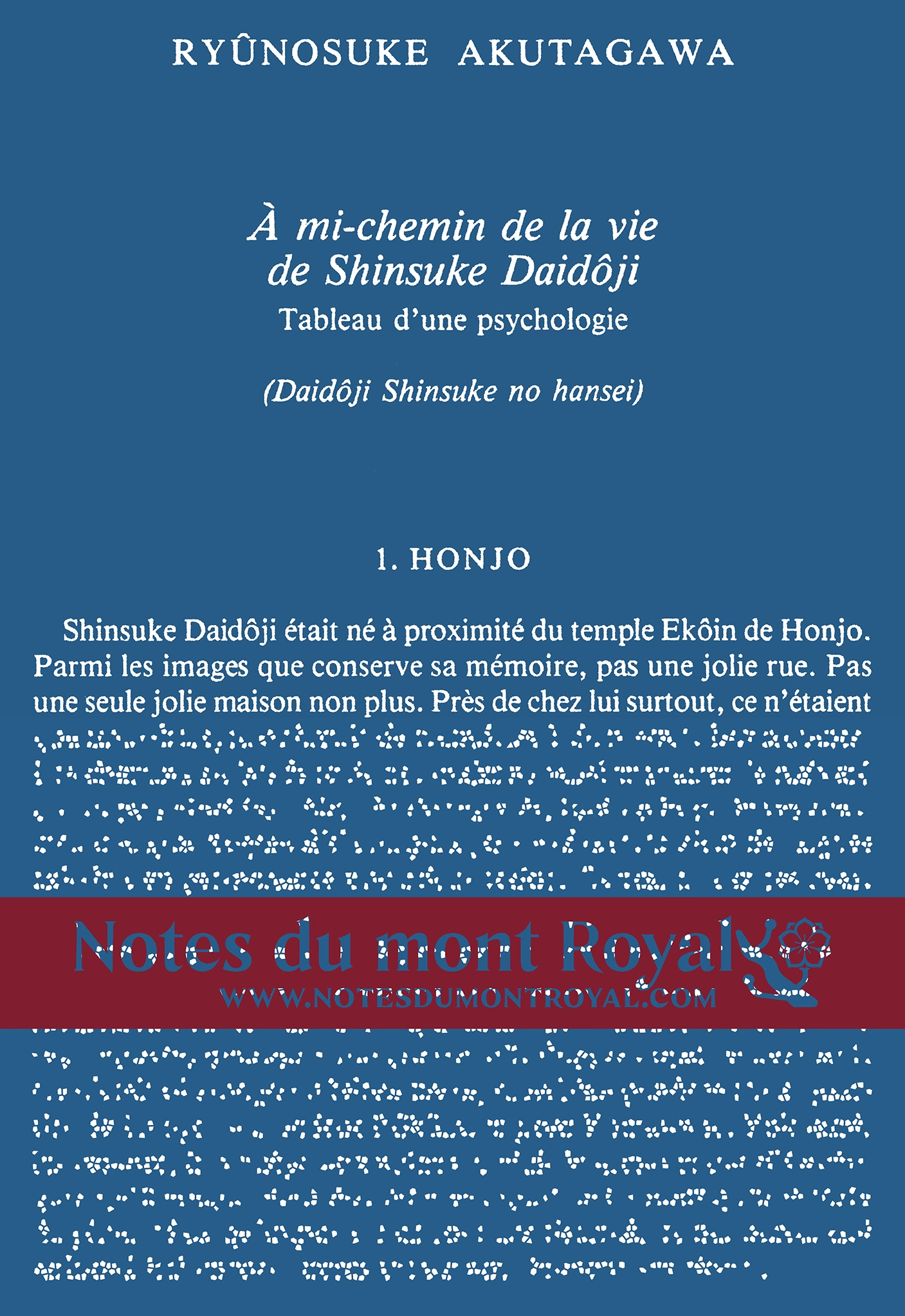
On “Halfway Through the Life of Daidōji Shinsuke”
Quotations
“Shinsuke had hated this poverty. No — even today, he preserves in the depths of his heart an echo of the hatred of that time, ineffaceable. He could not buy books, nor attend the summer courses, nor wear a new overcoat. But his comrades enjoyed all these privileges. He had envied them. And even, at times, been jealous of them. This envy, this jealousy, he refused nonetheless to admit. Because he had nothing but contempt for their intellectual abilities.”
Akutagawa, Ryūnosuke, « À mi-chemin de la vie de Shinsuke Daidôji : tableau d’une psychologie » (Halfway Through the Life of Daidōji Shinsuke: A Portrait of a Psychology), trans. from the Japanese by Edwige de Chavanes. In Anthologie de nouvelles japonaises contemporaines. 1 (Anthology of Contemporary Japanese Short Stories. 1), Paris: Gallimard, coll. « Du monde entier », 1986.
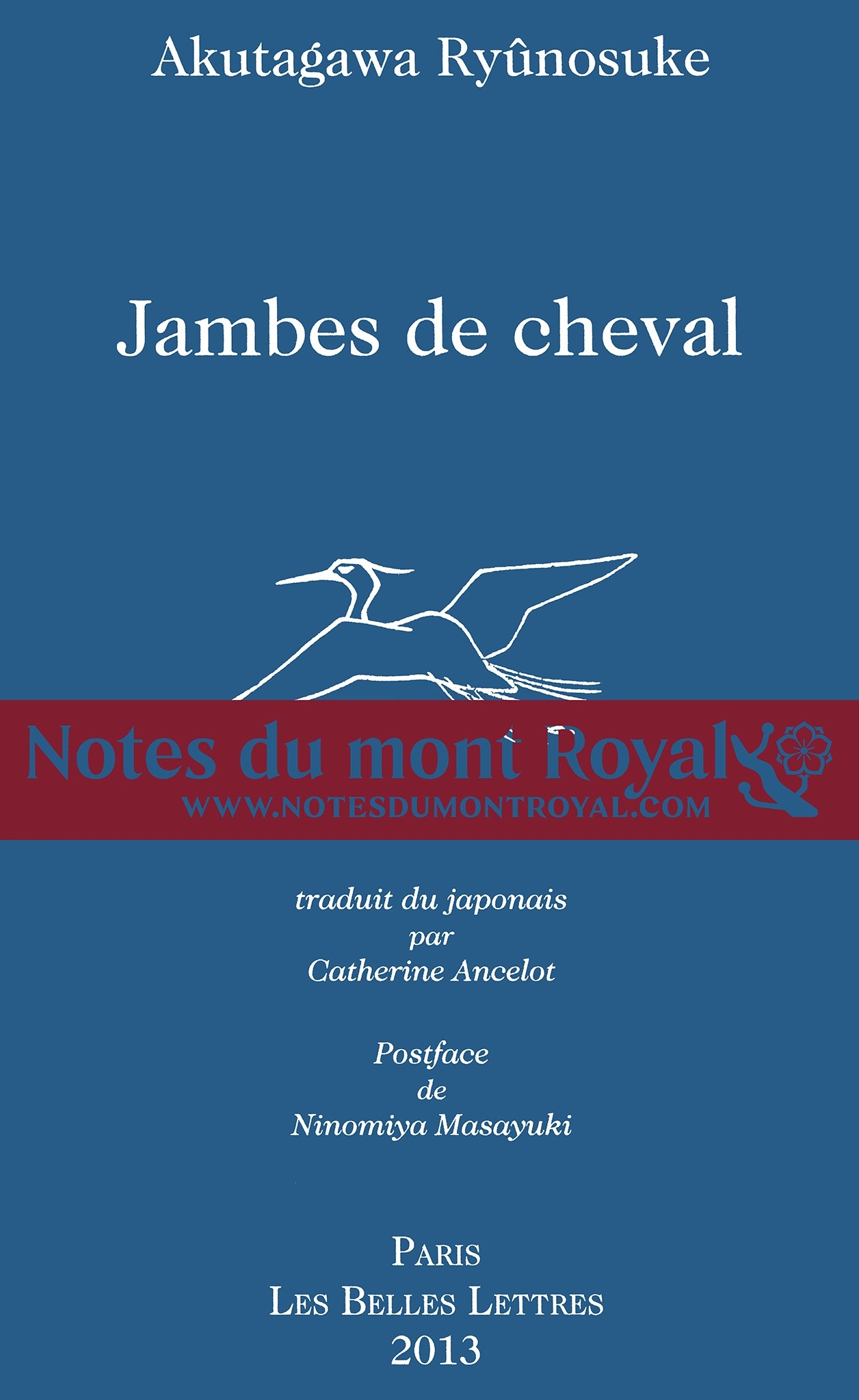
On Horse Legs
Quotations
“Hanzaburō was once again seized with stupefaction. According to this exchange, firstly, he was dead. Secondly, three days had already elapsed. Thirdly, his legs were decomposed. All this was absurd. Come now, did his legs not obey him just as… Scarcely had he tried to put one foot forward than he let out a resounding cry. Not without reason. White trousers with an impeccable crease and matching shoes, his legs both buckled under the wind coming in through the window! At this spectacle, Hanzaburō nearly doubted his own eyes.”
Akutagawa, Ryūnosuke, Jambes de cheval (Horse Legs), trans. from the Japanese by Catherine Ancelot, afterword by Ninomiya Masayuki, Paris: Les Belles Lettres, coll. « Collection Japon. Série Fiction », 2013.
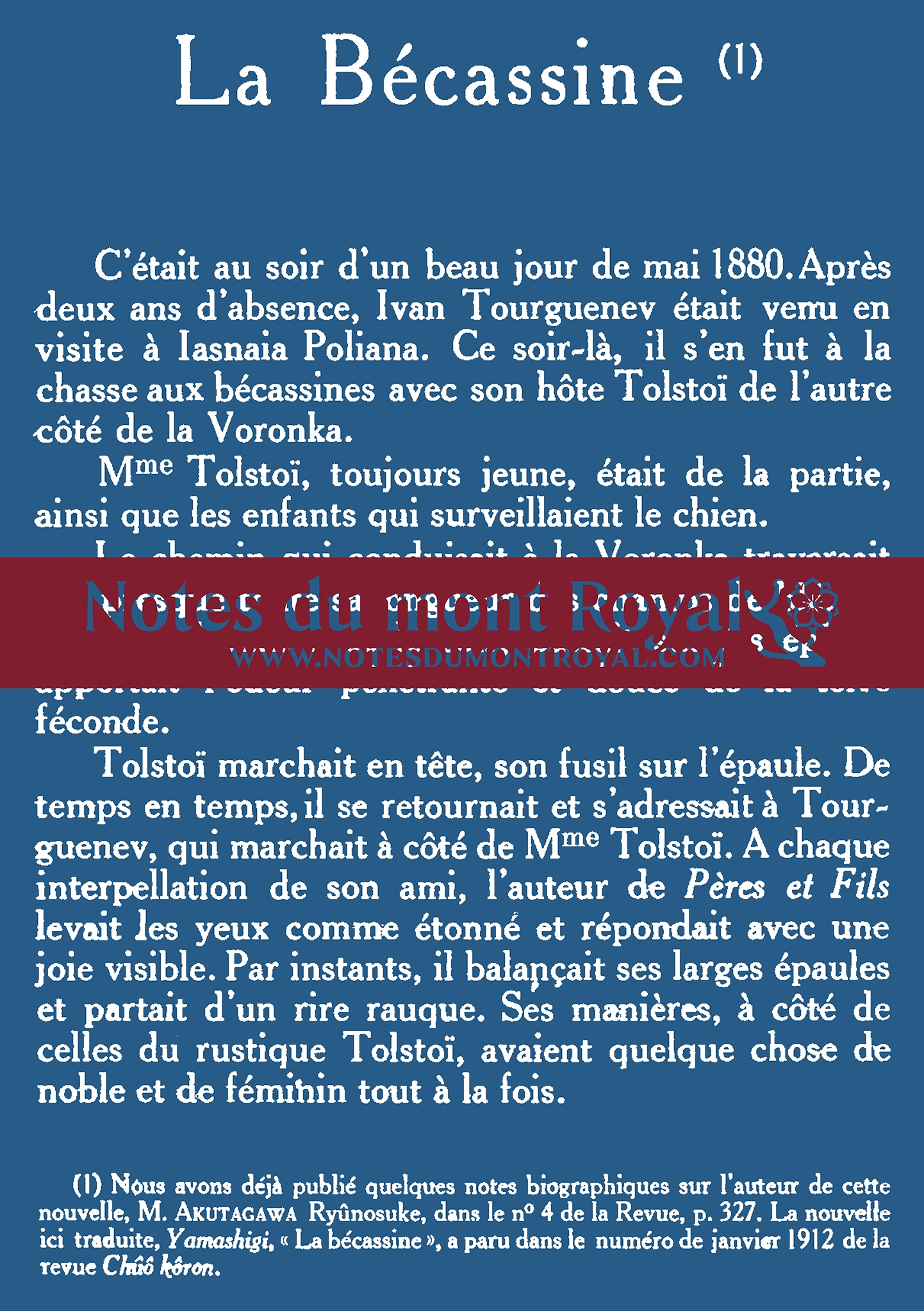
On “The Snipe”
Quotations
“Just at that moment, cries were heard outside; soon hurried footsteps came up the stairs, and an instant later the door opened abruptly. Five or six people — men, women, and children — burst into the room, each shouting something different.
’Papa, we’ve found it,’ cried Ilya cheerfully, at the head of the group, brandishing the snipe.”
Akutagawa, Ryūnosuke, « La bécassine » (The Snipe), trans. from the Japanese by Horiguchi Daigaku, Japon et Extrême-Orient (Japan and the Far East), no. 7-8 (July-August 1924), pp. 1-12.
Downloads
Printed Works
On “The Faith of Wei Sheng”
Quotations
“Frowning darkly, Wei Sheng began to pace, at an ever quicker step, the sandbank over which the shadow of night was creeping. Meanwhile, the waters of the river gained, little by little, inch by inch, foot by foot, upon the sandbank, while the smell of algae and water rising from the river began, icy, to cling to his skin. He raised his eyes: over there, above the bridge, the luminous brightness of the setting sun had already died away, and only the balusters of the stone parapet, all black, hatched in clean lines the night-blued sky. But the woman still does not come.”
Akutagawa, Ryūnosuke, « La foi de Wei Cheng » (The Faith of Wei Sheng), trans. from the Japanese by Edwige de Chavanes. In Les noix, la mouche, le citron (The Walnuts, the Fly, the Lemon), Arles: Éditions P. Picquier, 1991.
On The Sorceress
Quotations
« 「俊さん。」――さう云ふ声が一瞬間、信子の唇から洩れようとした。実際俊吉はその時もう、彼女の俥のすぐ側に、見慣れた姿を現してゐた。が、彼女は又ためらつた。その暇に何も知らない彼は、とうとうこの幌俥とすれ違つた。薄濁つた空、疎らな屋並、高い木々の黄ばんだ梢、――後には不相変人通りの少い場末の町があるばかりであつた。
「秋――」
信子はうすら寒い幌の下に、全身で寂しさを感じながら、しみじみかう思はずにゐられなかつた。 »
秋 (Autumn) on Japanese Wikisource, [online], accessed 10 July 2026.
“’Shun-san!’ For the space of a second, this cry nearly escaped her lips. Indeed, at that moment, Shunkichi revealed his familiar silhouette right beside the carriage. She hesitated once more. He, suspecting nothing, at last passed the hooded carriage. The greyish sky, the irregular rooftops of the houses, the trunks of the tall trees spreading their branches… Then there was only the outskirts, with its little-frequented streets. Beneath the slightly cold hood, Nobuko felt with every fibre of her body the melancholy of the autumn season and, in spite of herself, a faint cry escaped her lips.”
Akutagawa, Ryūnosuke, La magicienne (The Sorceress), trans. from the Japanese by Élisabeth Suetsugu, Arles: P. Picquier, 1999.
“’Sunsan!’ This call was about to escape from Nobuko’s mouth. In effect, at that instant, the familiar silhouette of her cousin appeared beside the kuruma7Everything that rolls, in Japan, is kuruma.. But Nobuko hesitated again, and Sunkiti, not suspecting his cousin’s presence, passed the carriage.
A gloomy sky, the uneven rooftops of a lonely suburb, the coloured leaves of the tall trees, the landscape of the dim street unrolling before her… And in her kuruma, into which the cool evening air was already slipping, feeling with her whole being a painful solitude, Nobuko could not help saying to herself: ’Autumn!’.”
Akutagawa, Ryūnosuke, « L’automne » (Autumn), trans. from the Japanese by Sioden Humiko (Shioden Fumiko), Extrême-Asie (Far Asia), no. 46 (April 1930), pp. 205-212.
“Was Nobuko about to call out: ’Shun-san!’ This cry nearly burst from her lips. The familiar silhouette of Shun-kichi happened to be, at that very moment, beside her rickshaw. She hesitated once more, and Shun-kichi, suspecting nothing, went by.
The slightly clouded sky, the scattered houses, the tall yellowed treetops… There remained on her horizon only the distant little quarter, with its road of rare passers-by. ’Autumn!’ thought Nobuko, beneath the cold tarpaulin of the rickshaw, and the despair of solitude suddenly overcame her entirely.”
Akutagawa, Ryūnosuke, « Le nez • L’automne » (The Nose • Autumn), trans. from the Japanese by Kaze Keita, Les Œuvres libres (The Free Works), no. 106 (March 1955), pp. 108-124.
« 横浜の或亜米利加人へ雛を売る約束の出来たのは十一月頃のことでございます。紀の国屋と申したわたしの家は親代々諸大名のお金御用を勤めて居りましたし、殊に紫竹とか申した祖父は大通の一人にもなつて居りましたから、雛もわたしのではございますが、中々見事に出来て居りました。 »
雛 (Dolls) on Aozora Bunko, [online], accessed 10 July 2026.
“A promise was thus made to hand over the dolls around the month of November to an American of Yokohama. My family, which bears the name Kinokuniya, had assured from generation to generation the role of creditor to the daimyōs, and my grandfather who, I believe, was called Shichiku, was a man versed in the diversions. At the risk of the modesty that ought to temper my words, I am obliged to say that these dolls — my dolls, then — were of a very fine make.”
Akutagawa, Ryūnosuke, La magicienne (The Sorceress), trans. from the Japanese by Élisabeth Suetsugu, Arles: P. Picquier, 1999.
“The undertaking to sell the dolls to an American residing in Yokohama was made in the month of November. For generations, our house, whose trade name was Kinokuni-ya, had lent money to the feudal lords. It was my grandfather, named Shichiku, a man full of experience and detached from the goods of this world, who had given me the dolls; they were nonetheless, I may say, of excellent workmanship.”
Akutagawa, Ryūnosuke, « Les poupées » (The Dolls), trans. from the Japanese by Serge Elisséeff (Serge Elisséev), Japon et Extrême-Orient (Japan and the Far East), no. 4 (March 1924), pp. 327-346; repr. in Neuf nouvelles japonaises (Nine Japanese Short Stories), Paris: G. Van Oest, 1924.
Downloads
Printed Works
- Partial translation of La magicienne (The Sorceress) by Serge Elisséeff (Serge Elisséev) (1924). (Google Books).
- Partial translation of La magicienne (The Sorceress) by Sioden Humiko (Shioden Fumiko) (1930). (Bibliothèque nationale de France (BnF)).
- Partial translation of La magicienne (The Sorceress) by Sioden Humiko (Shioden Fumiko) (1930), copy. (Google Books).
On The Life of an Idiot and Other Stories
Quotations
“[…] at some point I must have taken a wrong turn, for I suddenly found myself before the funeral hall of Aoyama. It had been fully ten years since I had last passed before this building — since, precisely, the funeral ceremony of Natsume Sōseki. Ten years earlier, too, I had not been happy. But I was at least at peace. My eyes fixed on the expanse of gravel that stretched within the gate, I saw again the banana tree of the ’Sōseki Villa.’ I could not help feeling that my life, too, had reached its term. Nor could I defend myself from the sentiment that it was not chance which, after ten years, had led my steps here.”
Akutagawa, Ryūnosuke, La vie d’un idiot et autres nouvelles (The Life of an Idiot and Other Stories), trans. from the Japanese by Edwige de Chavanes, preface by Jeannine Kohn-Étiemble, Paris: Gallimard, coll. « Connaissance de l’Orient », 1987.
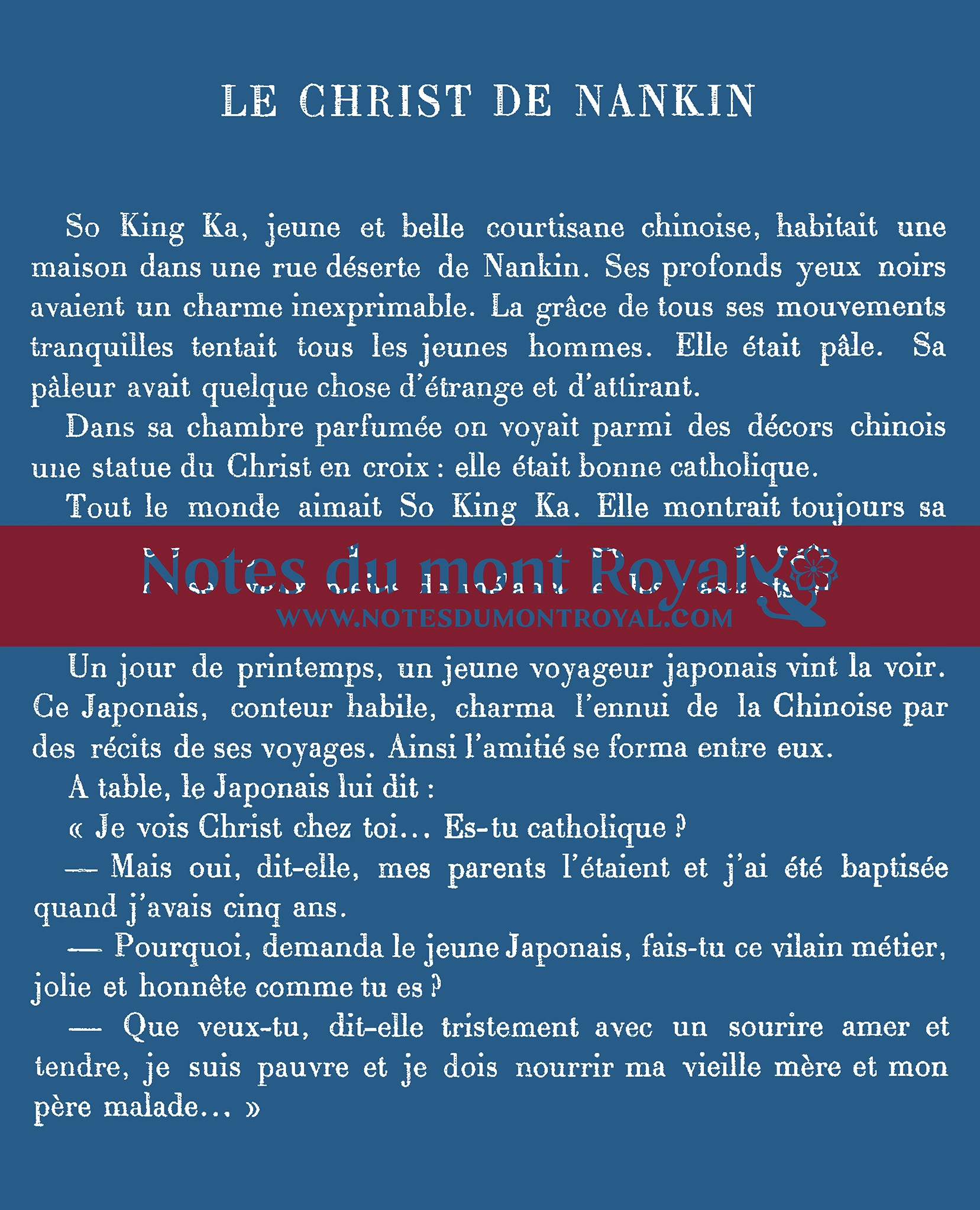
On “The Christ of Nanjing”
Quotations
“At the same moment, the statue of Christ that hung on the wall fell with a clatter. A heavy silence lasted several seconds. Then, feeling a great mysterious emotion, the young Chinese woman picked up the statue and looked again at the face of the mute foreigner and the face of Christ. She remained moved. The face of the holy Christ bore a singular resemblance to that of the foreigner. All at once a bright smile appeared on the pale face of the Chinese woman, and she approached this man with an expression of joy.”
Akutagawa, Ryūnosuke, « Le Christ de Nankin » (The Christ of Nanjing), trans. from the Japanese by Matsuo Kuni (Matsuo Kuninosuke), Bifur, no. 8 (June 1931), pp. 97-100.
Downloads
Printed Works
- Translation of « Le Christ de Nankin » (The Christ of Nanjing) by Matsuo Kuni (Matsuo Kuninosuke) (1931). (Bibliothèque nationale de France (BnF)).
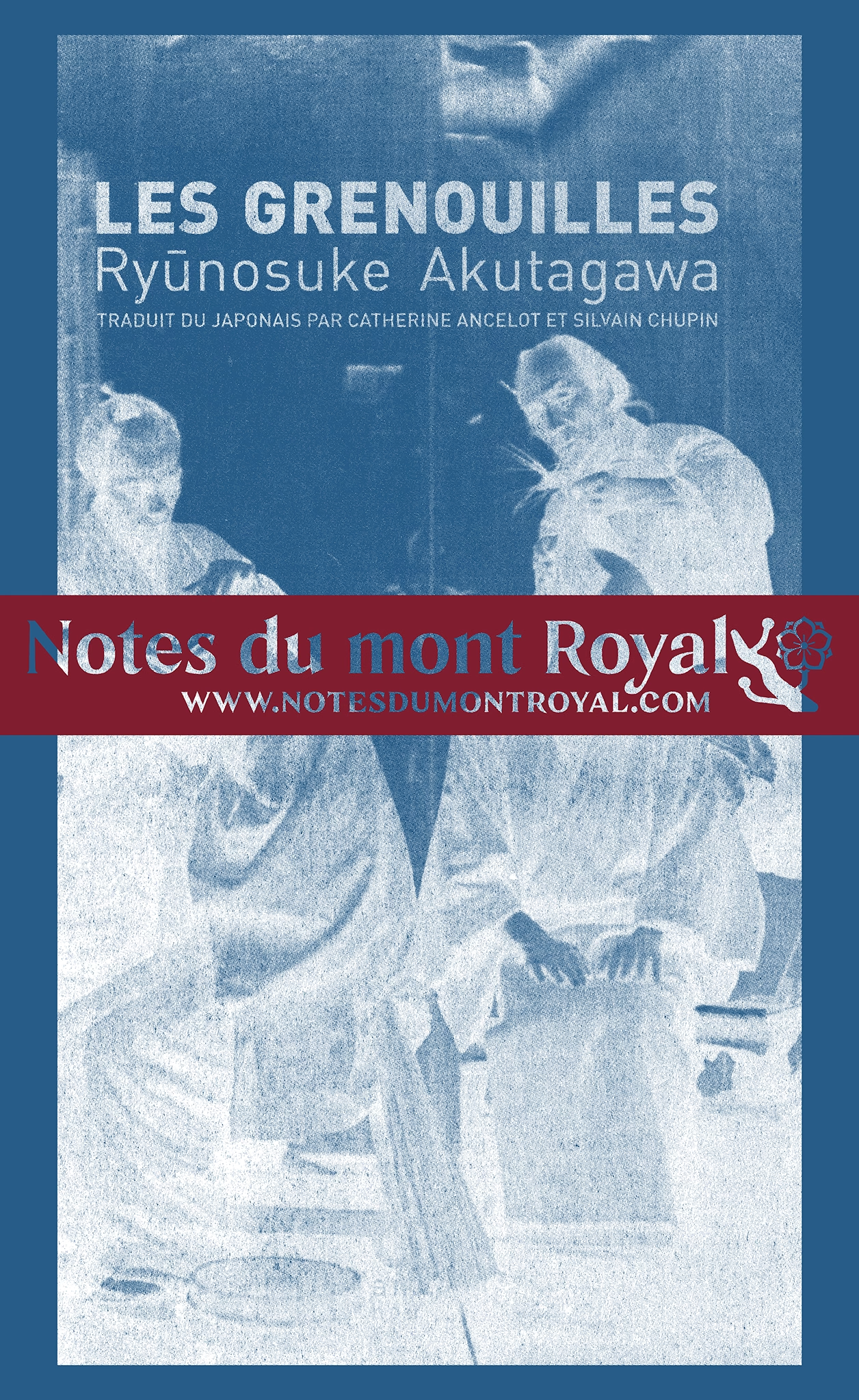
On The Frogs
Quotations
« 渡辺の橋の供養の時、三年ぶりで偶然袈裟にめぐり遇った己は、それからおよそ半年ばかりの間、あの女と忍び合う機会を作るために、あらゆる手段を試みた。そうしてそれに成功した。いや、成功したばかりではない、その時、己は、己が夢みていた通り、袈裟の体を知る事が出来た。が、当時の己を支配していたものは、必しも前に云った、まだあの女の体を知らないと云う未練ばかりだった訳ではない。己は衣川の家で、袈裟と一つ部屋の畳へ坐った時、既にこの未練がいつか薄くなっているのに気がついた。それは己がもう童貞でなかったと云う事も、その場になって、己の欲望を弱める役に立ったのであろう。しかしそれよりも、主な原因は、あの女の容色が、衰えていると云う事だった。 »
袈裟と盛遠 (Kesa and Moritō) on Aozora Bunko, [online], accessed 10 July 2026.
“After three years without having seen her, I met her again by chance at the purification ceremony of the new bridge of Watanabe, then, for six months, I employed every ruse in the world to meet her in secret. And I attained my ends. More than that, even. I came to know her body, as I had dreamed of. And yet, the sentiment that animated me then was no longer merely the vexation of not yet having possessed her. When we took our places, the two of us, on a mat in the house of Koromogawa, I perceived that, without my knowing, my regrets had grown less poignant. That I was no longer a virgin had doubtless helped to diminish my desire. But there was something else more decisive: the beauty of this woman had faded.”
Akutagawa, Ryūnosuke, Une vague inquiétude (A Vague Uneasiness), trans. from the Japanese by Silvain Chupin, preface by René de Ceccatty, Monaco: Éditions du Rocher, coll. « Nouvelle », 2005; augmented repr. under the title Les grenouilles (The Frogs), trans. from the Japanese by Catherine Ancelot and Silvain Chupin, Paris: Cambourakis, coll. « Littérature », 2024.
“It was on the day of the Buddhist festival, at the Bridge of Watanabe, that I met Kesa. A strange chance after three years of separation. I learned that she was married. For six months, I used manifold ruses to obtain from her a secret rendezvous. Not only did I obtain a rendezvous, but I came at last to know that body of which I had never ceased to dream. Now, at that moment, I found that there were in my heart other sentiments still than the ardent regret of having awaited this possession so long. At her side, in the Koromogawa House, I observed that the allure of her body no longer entirely filled my soul.
Perhaps the diminution of my desire was explained by the fact that I was no longer a virgin and that my first ardours had subsided. Perhaps also by another cause: Kesa’s face no longer radiated youth as it once had.”
Akutagawa, Ryūnosuke, « Kesa et Morito » (Kesa and Moritō), trans. from the Japanese by Matsuo Kuni (Matsuo Kuninosuke) and Émile Steinilber-Oberlin, France-Japon (France-Japan), no. 10 (July 1935), pp. 163-166.
Downloads
Printed Works
- Partial translation of Les grenouilles (The Frogs) by Matsuo Kuni (Matsuo Kuninosuke) and Émile Steinilber-Oberlin (1935). (Bibliothèque nationale de France (BnF)).
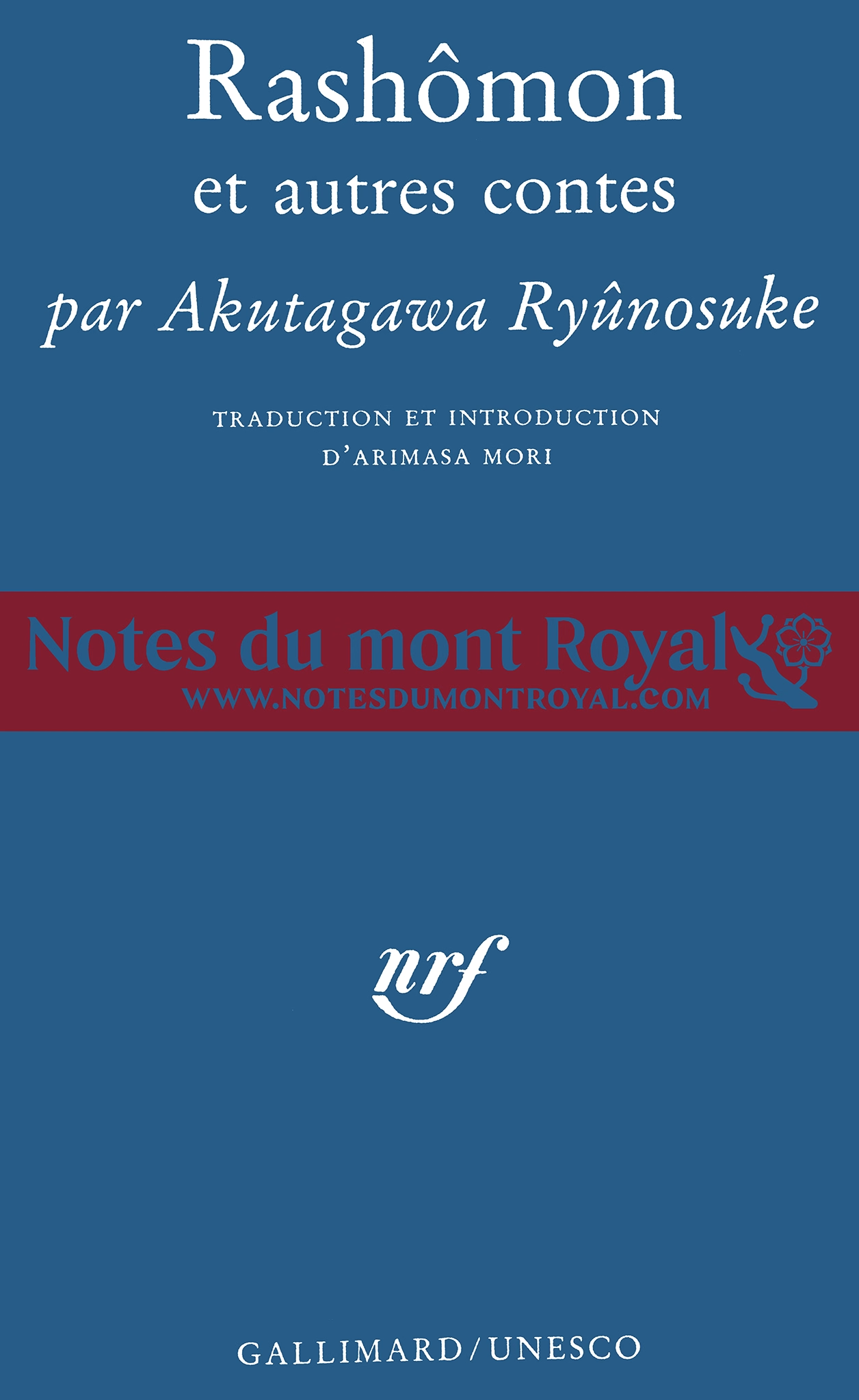
On Rashōmon and Other Tales
Quotations
« 或日の暮方の事である。一人の下人が、羅生門の下で雨やみを待つてゐた。
廣い門の下には、この男の外に誰もゐない。唯、所々丹塗の剝げた、大きな圓柱に、蟋蟀が一匹とまつてゐる。羅生門が、朱雀大路にある以上は、この男の外にも、雨やみをする市女笠や揉烏帽子が、もう二三人はありさうなものである。それが、この男の外には誰もゐない。 »
羅生門 (Rashōmon) on Japanese Wikisource, [online], accessed 10 July 2026.
“It happened one day at dusk: a man of low condition was there, beneath the Rashō Gate, awaiting a lull in the rain.
There was no one but him beneath the vast Gate. Alone, upon an enormous column whose red coating had fallen away in places, a cricket had settled. The Rashō Gate being on Suzaku Avenue, one would have expected to encounter there, besides this man, two or three others — women in conical hats or men crowned with eboshi8A tall bonnet, most often black, worn in former times by nobles. — seeking shelter from the rain. And yet, there was no one but him.”
Akutagawa, Ryūnosuke, Rashômon et autres contes (Rashōmon and Other Tales), trans. from the Japanese by Mori Arimasa, Paris: Gallimard, coll. « Connaissance de l’Orient », 1965; repr. with a preface by Claude Roy, Paris: Le Livre de poche, coll. « Le Livre de poche. Classique », 1969.
“The night was cool. The lackey of a samurai stood alone beneath the arcades of the Rashomon, waiting for the shower to pass.
This edifice had been raised facing the Avenue of Sujaku. It was not rare for passers-by, in sedge hats or noble headdresses, to come and shelter there from a downpour. But that evening, the lackey was alone; no other presence than that of a cricket, upon a faded red column.”
Akutagawa, Ryūnosuke, « Rashomon • Dans le taillis » (Rashomon • In the Coppice), trans. from the Japanese by Ono Yoshio and René de Berval, France-Asie (France-Asia), no. 103 (December 1954), pp. 217-225.
« 長崎あたりの村々には、時々日の暮の光と一しょに、天使や聖徒の見舞う事があった。現にあのさん・じょあん・ばちすたさえ、一度などは浦上の宗徒みげる弥兵衛の水車小屋に、姿を現したと伝えられている。と同時に悪魔もまた宗徒の精進を妨げるため、あるいは見慣れぬ黒人となり、あるいは舶来の草花となり、あるいは網代の乗物となり、しばしば同じ村々に出没した。 »
おぎん (O-Gin) on Japanese Wikisource, [online], accessed 10 July 2026.
“It happened at times that, beneath the rays of the setting sun, angels or saints would visit the villages of the Nagasaki region. It is even told that Saint John the Baptist once made his appearance at the mill of Miguel Yahei, a faithful of Urakami. The devil, for his part, to obstruct the religious zeal of the believers — transforming himself now into a strange negro, now into an exotic flower or a carriage with wattle blinds — was rife in those same villages.”
Akutagawa, Ryūnosuke, Rashômon et autres contes (Rashōmon and Other Tales), trans. from the Japanese by Mori Arimasa, Paris: Gallimard, coll. « Connaissance de l’Orient », 1965; repr. with a preface by Claude Roy, Paris: Le Livre de poche, coll. « Le Livre de poche. Classique », 1969.
“It even happened that angels and saints descended to visit the villages, around Nagasaki, with the rays of the crepuscular sun. It is even positively reported that once Saint John the Baptist appeared in the mill of Michel Yahei, at Urakami. For his part, the demon too appeared often in those same villages in the form of an unknown negro, an exotic flower, or a bamboo palanquin, in order to prevent the faithful from practising abstinence.”
Akutagawa, Ryūnosuke, Le nez et autres contes (The Nose and Other Tales), trans. from the Japanese by Maruyama Juntarō, Tōkyō: Hakusuisha, 1927.
« すると、一生懸命にのぼった甲斐があって、さっきまで自分がいた血の池は、今ではもう暗の底にいつの間にかかくれて居ります。それからあのぼんやり光っている恐しい針の山も、足の下になってしまいました。この分でのぼって行けば、地獄からぬけ出すのも、存外わけがないかも知れません。犍陀多は両手を蜘蛛の糸にからみながら、ここへ来てから何年にも出した事のない声で、「しめた。しめた。」 »
蜘蛛の糸 (The Spider’s Thread) on Japanese Wikisource, [online], accessed 10 July 2026.
“To tell the truth, his fierce struggle had not been in vain: the Pool of Blood he had left a moment before had already faded into the depths of the darkness. The distant glittering of the terrible Mount of Needles was likewise beneath his feet. At this rate, perhaps the escape from Hell would come about more easily than he had expected. Winding the spider’s thread around his arm, he said with a smile of satisfaction: ’I’ve got it! I’ve got it!’ in a tone forgotten since his arrival in this place, how many years ago now.”
Akutagawa, Ryūnosuke, Rashômon et autres contes (Rashōmon and Other Tales), trans. from the Japanese by Mori Arimasa, Paris: Gallimard, coll. « Connaissance de l’Orient », 1965; repr. with a preface by Claude Roy, Paris: Le Livre de poche, coll. « Le Livre de poche. Classique », 1969.
“Then he saw that his efforts had not been in vain: the Lake of Blood, in which he had still found himself a short time before, had disappeared into the darkness. He also saw the faint glow of the terrible Mountain of Needles below him. At this rate, escaping from the Underworld would perhaps be no more difficult than he had imagined. Gripping the thread with both his hands, Kandata began to laugh in a voice he had no longer used during all those years spent in the underworld: ’It’s going to work, I’m going to succeed.’”
Akutagawa, Ryūnosuke, « Le fil d’araignée » (The Spider’s Thread), trans. from the Japanese by Christopher Chassagneux and Lucie Demesy, La main de Thôt (The Hand of Thoth), no. 13, 2025.
“Climbing so hard was worth the trouble, for the Pool of Blood, where he had been until then, had now disappeared into the shadows below. Even the faint glow of the terrifying Mountain of Needles was beneath him. If he kept climbing at this rate, escaping from Hell might be easier than expected. Kandata wound the spider’s thread around his hands, and, in a voice he had not used since his arrival here, many years ago, he laughed and said: ’There it is, I’m there!’”
Akutagawa, Ryūnosuke, « Le fil de l’araignée » (The Spider’s Thread), indirect trans. from the English by Lucile Rusu with the collab. of Clara Wartelle-Sakamoto, after that of Anne McNulty and Sato Eriko. In Petites histoires japonaises : contes et nouvelles bilingues pour progresser en japonais (Little Japanese Stories: Bilingual Tales and Short Stories for Progressing in Japanese), Malakoff: A. Colin, 2022, pp. 38-61.
Downloads
Printed Works
- Partial translation of Rashômon et autres contes (Rashōmon and Other Tales) by Christopher Chassagneux and Lucie Demesy (2025). (La main de Thôt).
- Partial translation of Rashômon et autres contes (Rashōmon and Other Tales) by Ono Yoshio and René de Berval (1954). (Google Books).
Bibliography
- Bonneau, Georges, Histoire de la littérature japonaise contemporaine (1868-1938) (History of Contemporary Japanese Literature (1868-1938)), preface by Kikuchi Kan, Paris: Payot, 1940.
- Chavanes, Edwige de, « Akutagawa Ryūnosuke (1892-1927) ». In Cinéma et littérature au Japon : de l’ère Meiji à nos jours (Cinema and Literature in Japan: From the Meiji Era to Our Day), ed. Max Tessier, Paris: Centre G. Pompidou, coll. « Cinéma singulier », 1986, pp. 44-45.
- Collasse, Richard, Dictionnaire amoureux du Japon (A Lover’s Dictionary of Japan), Paris: Plon, coll. « Dictionnaire amoureux », 2021.
- Guillamaud, Jean, Histoire de la littérature japonaise (History of Japanese Literature), Paris: Ellipses, coll. « Littératures. Série Littératures du monde », 2008.
- Matéo, Pascal, « Ryûnosuke Akutagawa, “Rashômon” (1915). Les ténèbres d’un Japon de légende » (Ryūnosuke Akutagawa, “Rashōmon” (1915). The Shadows of a Legendary Japan), Le Point Références, no. 80 (April-June 2020), pp. 64-65.
- Matsuo, Kuni (Matsuo, Kuninosuke), Histoire de la littérature japonaise : des temps archaïques à 1935 (History of Japanese Literature: From Archaic Times to 1935), in collab. with Kawaji Ryūkō and Alfred Smoular, prefaces by Anatole de Monzie, Émile Steinilber-Oberlin, and Noguchi Yonejirō, Paris: Société française d’éditions littéraires et techniques, coll. « Bibliothèque du hérisson », 1935.
- Origas, Jean-Jacques, « Akutagawa Ryūnosuke (1892-1927) », Encyclopædia universalis, [online], accessed 10 July 2026.
- Pinguet, Maurice, La mort volontaire au Japon (Voluntary Death in Japan), Paris: Gallimard, coll. « Bibliothèque des histoires », 1984.
- Sieffert, René, La littérature japonaise (Japanese Literature), Paris: Librairie A. Colin, coll. « Collection A. Colin », 1961; new ed. with an update by Katô Shuichi, Paris: Publications orientalistes de France, coll. « Langues et civilisations. Littérature », 1986.