
The Analects of Confucius, Sovereign Without a Crown
Translated from French • English (anglais)
« Without this fundamental key [The Analects], one cannot gain access to Chinese civilization. And whoever remained ignorant of that civilization could never attain anything more than a partial understanding of human experience. »
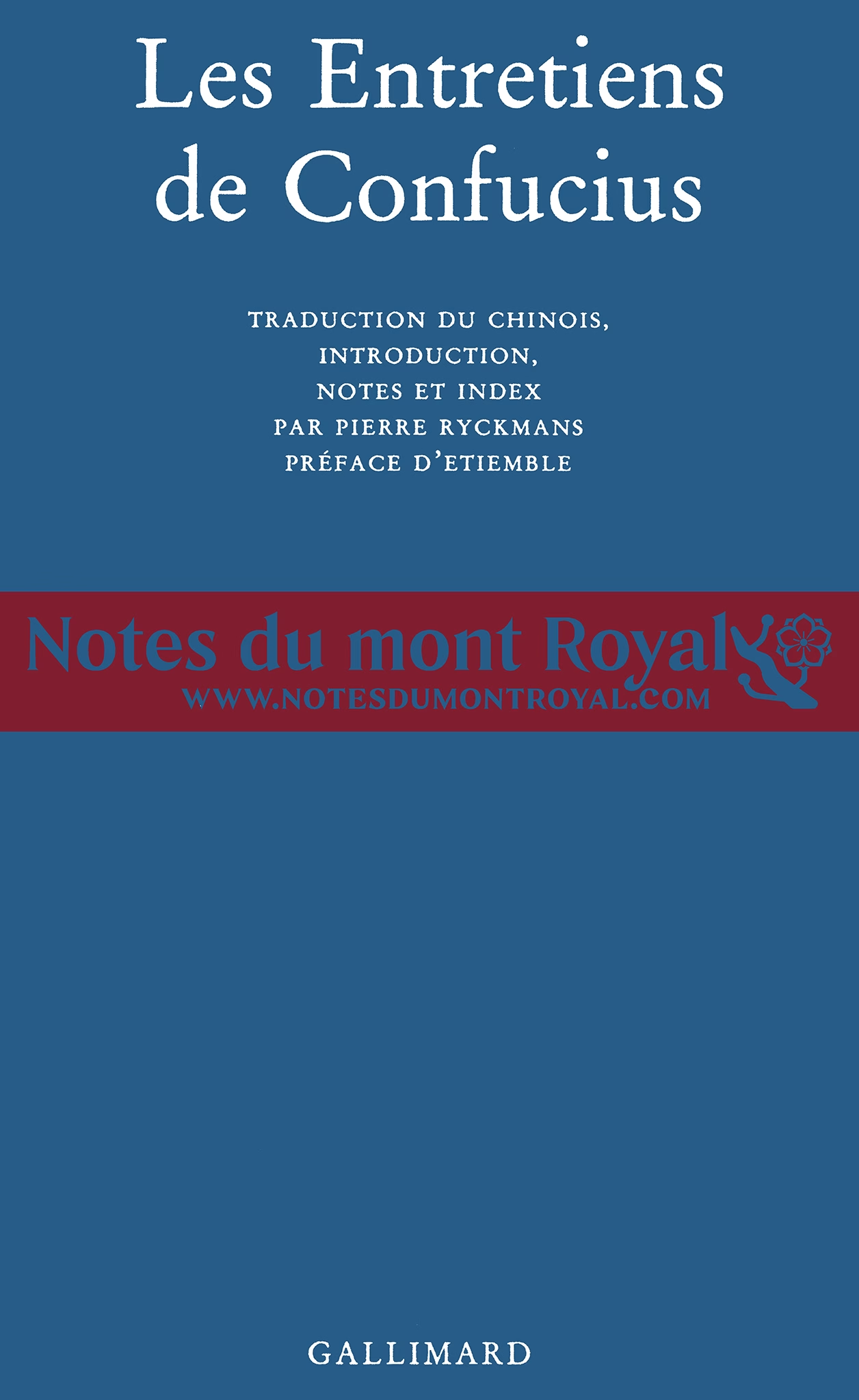
Confucius. Les Entretiens de Confucius (The Analects of Confucius), trans. from Chinese by Pierre Ryckmans, pref. by René Étiemble. Paris: Gallimard, “Connaissance de l’Orient” coll., 1987.
The history of thought offers few examples of an influence as far-reaching and as enduring as that of the Venerable Master Kong, or Kongfuzi1Rejected forms:
Cong fou tsëe.
Krong-fou-tsé.
K’ong-fou-tseu.
Kong-fou-tze.
Khoung-fu-tzée.
Khoung-fou-dze.
Cung-fou-tsée.
Khung-fu-dsü.
Kung-fu-tsu.
Kung fu-tzu.
Cun-fu zu.
Cum-fu-çu.. If we are to judge his greatness by the deep mark he has imprinted upon all the peoples of East Asia, we may assuredly call him “the greatest teacher […] the ages have ever produced.” It is in his Analects (Lunyu)2Rejected forms:
Analectes (Analects).
Dialogues.
Les Annales (The Annals).
Les Propos (The Sayings).
Les Entretiens philosophiques (Philosophical Conversations).
Les Discussions philosophiques (Philosophical Discussions).
Le Livre des entretiens ou des discours moraux (The Book of Conversations or of Moral Discourses).
Discours et paroles (Discourses and Sayings).
Aphorismes (Aphorisms).
Conversations avec ses disciples (Conversations with His Disciples).
Liber sententiarum (The Book of Sentences).
Ratiocinantium sermones (The Conversations of the Rationalists).
Dissertæ sententiæ.
Lén-yù.
Luen yu.
Louen yu.
Loung yu.
Lien-yu.
Liun iu.
Liun-ju.
Loun-yu.
Loun iu.
Lún-iù.
Not to be confused with:
Les Entretiens familiers de Confucius (Kongzi jiayu) (The Familiar Discourses of Confucius), which form a sort of heterodox supplement to the collection of the Analects. that his ardent love of humanity and his sublime morality, drawn from the wellsprings of common sense, shine forth; it is there that his constant concern is manifest to restore to human nature that first lustre received from Heaven, but dimmed by the shadows of ignorance. One will not be astonished, then, that the Jesuit fathers, who introduced him to Europe and made him admired there under the Latinized name of Confucius, conceived for him an enthusiasm equal to that of the Chinese. They saw in his Analects the pearls of China, or something of still greater price, for pretiosior est cunctis opibus [sapientia] (wisdom is more precious than pearls)3Pr 3:15 (trans. La Bible: traduction officielle liturgique (The Bible: Official Liturgical Translation)).. And they concluded that “these teachings are not only good for the people of China, but […] that there are few Frenchmen who would not deem themselves […] very fortunate if they could put them into practice.” Voltaire himself, won over, hung in his study a portrait of the Chinese sage, beneath which he set these four lines:
« Sole wholesome interpreter of reason,
Without dazzling the world, enlightening minds,
He spoke only as a sage and never as a prophet;
Yet he was believed, even in his own country. »Voltaire. “De la Chine” (“On China”). Œuvres complètes de Voltaire (Complete Works of Voltaire), vol. 40, Questions sur l’Encyclopédie, par des amateurs (Questions on the Encyclopedia, by Amateurs), IV, César-Égalité (Caesar-Equality). Oxford: Voltaire Foundation, 2009.
The Self-Evidence of Right Reason
Considered from the twofold standpoint of morality and politics, Confucius’s doctrine bears comparison with that which Socrates was teaching at about the same time. “Friends of reason, enemies of enthusiasm” (Voltaire), Confucius and Socrates clothed ancient wisdom in that gentleness, that self-evidence, that calm capable of touching the roughest of minds. Never, perhaps, was the human mind more worthily represented than by these two men. Superior in their philosophy, they were no less so in their judgment. Thus they always knew how far one must go and where one must stop. And if, nevertheless, they strayed from the straight path, their good sense brought them back to it — wherein they hold a considerable advantage over many philosophers of our day, whose reasonings are so convoluted, so false, whose subtleties are so appalling, that they can scarcely understand themselves. “The Master said: ’No one would think of going out except through the door. Why, then, do people seek to walk outside the Way?’” (VI.17)
One will regret, then, the opinion of Hegel, who, finding in The Analects none of those aberrations that he called philosophy, settled the matter with a dreadful word: “it would have been better for Confucius’s reputation had his work not been translated”4Hegel, Georg Wilhelm Friedrich. Leçons sur l’histoire de la philosophie (Lectures on the History of Philosophy), trans. from German by Jean Gibelin. Paris: Gallimard, 1954.. This wholly Germanic contempt is all the more strange in that Germany possesses, with the Conversations of Goethe, a book eminently close to The Analects both in its serene beauty and in the living presence of a Master. Let there be no mistake about it! To judge Confucius unworthy of translation is to reject reason itself — “that inner truth which is in the soul of all men, and which our philosopher ceaselessly consulted [in order to] guide all his words” (Jean de Labrune).
The Way of the Sage
Like so many other “teachers” of the human race — like the Buddha in India, like Zarathustra in Persia — Confucius was not a writer, but a Master who left to his disciples the task of transcribing his teachings. Moreover, a stranger to grand speeches and to misplaced eloquence, he preferred to them a recollected attitude, “like that of a musician bent over his instrument to draw from it the most beautiful melodies”5After the luminous image of Antoine-Joseph Assaf.. He went so far at times as to sigh: “I would like to speak no more.” To the disciples who were moved by his silences, he retorted with an almost cosmic majesty: “Does Heaven speak? Yet the four seasons follow their course, yet the hundred creatures are born. Does Heaven speak?” (XVII.19)
He humbly declared to whoever would hear him: “I transmit, I invent nothing […] and I love Antiquity” (VII.1). In reality, beneath the features of the scrupulous guardian there showed through a reformer. He did not content himself with preserving the rites (li), knowledge (zhi), the sense of humanity (ren); he regenerated them, moralized them, and propagated them with a tragic devotion. Conscious that “his mission is heavy, and his road long” (VIII.7), he nevertheless took courage in the thought of fulfilling a true celestial mandate: “King Wen is dead. Now, is it not I who am entrusted with the deposit of civilization? Had Heaven sworn its ruin, why would it have confided it to a mortal like me? And if Heaven has decided to preserve this deposit, what have I to fear […]?” (IX.5)
The Empire of Virtue
A frequent word in The Analects is that of “honourable man” (junzi), which originally designated a gentleman of noble race and family, but to which Confucius gives a new meaning by replacing the aristocracy of blood with that of the heart. The man of quality is no longer defined by the birth he receives from the hands of chance, but by the moral elevation and the sensibility he acquires through study6As Cyrille Javary points out, France was to wait twenty-three centuries after Confucius to see Figaro, the count’s valet, claim feelings of equality and of revenge against the privileges of his master: “My lord Count […]. Because you are a great nobleman, you believe yourself a great genius!… Nobility, fortune, rank, positions; all that makes one so proud! What have you done to deserve so many blessings? You took the trouble to be born, and nothing more. For the rest, a rather ordinary man! Whereas I,” etc.. Like “the Polar star” (II.1), unmoving and central, he does not worry about going unnoticed; he seeks rather to do something noteworthy: “The Master said: ’It is no misfortune to be misunderstood by men; but it is a misfortune to misunderstand them’” (I.16). Where will one find a finer maxim, a greater indifference toward glory and success? What matters, in the end, that Confucius remained, his whole life long, a sovereign without a crown? He has built an Empire whose invisible frontiers extend to those of humanity.
For Further Reading
On The Analects of Confucius
Quotations
« 子曰:「不知命,無以爲君子也;不知禮,無以立也;不知言,無以知人也。」 »
論語 on Wikisource 中文, [online], accessed April 15, 2026.
« Confucius said: “He who does not know destiny cannot live as an honourable man. He who does not know the rites does not know how to conduct himself. He who does not know the meaning of words cannot know men”. »
Confucius. Les Entretiens de Confucius (The Analects of Confucius), trans. from Chinese by Pierre Ryckmans, pref. by René Étiemble. Paris: Gallimard, “Connaissance de l’Orient” coll., 1987.
« The Master said: “He who does not know his lot could not be a man of worth; he who does not know the rites could not hold his rank; he who does not know the meaning of words could not judge men”. »
Confucius. Les Entretiens de Confucius et de ses disciples (The Analects of Confucius and His Disciples), trans. from Chinese by Jean Levi. Paris: A. Michel, “Spiritualités vivantes” coll., 2016; repr. under the title Entretiens (Analects), Paris: Les Belles Lettres, 2019.
« The Master said: “Whoever does not recognize the celestial decree could not be a man of worth. Whoever does not possess the rites could not assert himself. Whoever does not know the value of words could not know men”. »
Confucius. Les Entretiens (The Analects), trans. from Chinese by Anne Cheng. Paris: Éditions du Seuil, “Points. Sagesses” coll., 1981.
« Confucius said: “Without knowledge of destiny, one could not become a man of quality. Without knowledge of courtesy, one could not hold to it. Without knowledge of the meaning of words, one could not understand men”. »
Confucius. Les Entretiens de Confucius et de ses disciples (The Analects of Confucius and His Disciples), trans. from Chinese by André Lévy. Paris: Flammarion, “GF” coll., 1994.
« Confucius said: “If one does not know destiny, nothing allows one to be a man of worth. If one does not know the rites, nothing allows one to establish oneself in society. If one does not know the meaning of words, nothing allows one to know men!” »
Philosophes confucianistes (Confucian Philosophers), trans. from Chinese by Charles Le Blanc and Rémi Mathieu. Paris: Gallimard, “Bibliothèque de la Pléiade” coll., 2009.
« The philosopher said: “If one does not believe oneself charged to fulfill a mission, a mandate, one cannot be considered a superior man.
If one does not know the rites or the laws that govern social relations, one has nothing by which to establish one’s conduct.
If one does not know the value of men’s words, one does not know the men themselves”. »
Confucius and Mencius. Les Quatre Livres de philosophie morale et politique de la Chine (The Four Books of Moral and Political Philosophy of China), trans. from Chinese by Guillaume Pauthier. Paris: Charpentier, 1841.
« The Master: “He who does not know the decree could not become a noble man. He who does not know the rites could not hold himself. He who does not know words could not know men”. »
Confucius. Le Livre de la sagesse de Confucius (The Book of the Wisdom of Confucius), trans. from Chinese by Eulalie Steens. Monaco; Paris: Éditions du Rocher, “Les Grands Textes spirituels” coll., 1996.
« The Master said: “He who does not know the will of Heaven (the natural law) will never be a sage. He who does not know the rules and the usages will not be constant in his conduct. He who does not know how to discern the true from the false in the discourses of men cannot know men”. »
Confucius and Mencius. Les Quatre Livres (The Four Books), trans. from Chinese into French and Latin by Séraphin Couvreur. Hejian: Imprimerie de la mission catholique, 1895.
« Magister ait: “Qui non cognoscit Cœli mandata, non habet quo fiat sapiens vir. Qui non novit ritus, non habet quo consistat, id est, non habet certam legem qua constanter se dirigat. Qui nescit discernere (examinare et æstimare) hominum dicta, non habet quo noscat homines”. »
Confucius and Mencius. Les Quatre Livres (The Four Books), trans. from Chinese into French and Latin by Séraphin Couvreur. Hejian: Imprimerie de la mission catholique, 1895.
« The Master said: “He who does not know the celestial decree could not be an honourable man. He who does not know the rules and the usages could not steady himself. He who does not know the meaning of utterances cannot know men”. »
Confucius. Entretiens du Maître avec ses disciples (Conversations of the Master with His Disciples), trans. from Chinese by Séraphin Couvreur, rev. trans. and afterword by Muriel Baryosher-Chemouny. Paris: Éd. Mille et une nuits, “Mille et une nuits” coll., 1997; repr. under the title Paroles de Confucius, Entretiens (Sayings of Confucius, Analects), Paris: Hugo poche, “Hugo poche: sagesses” coll., 2023.
« Confucii effatum: “Nec sapientiam apprehendere, qui Cæli legem; nec in virtute stare, qui rituum honestatem; nec homines potest dignoscere, qui verborum artem ignorat”. »
Confucius and Mencius. Sinensis imperii libri classici sex (Six Classical Books of the Chinese Empire), trans. from Chinese into Latin by François Noël. Prague: per J. J. Kamenicky, 1711.
« Confucius said: “One cannot attain wisdom if one does not know the law of heaven, nor establish oneself in virtue if one is ignorant of the rites of propriety, nor discern men if one does not know the art of speaking”. »
Confucius and Mencius. Les Livres classiques de l’Empire de la Chine (The Classical Books of the Empire of China), indirect trans. from Latin by François-André-Adrien Pluquet, after that of François Noël. Paris: de Bure; Barrois aîné et Barrois jeune, 1784.
« Confucius aiebat: “Qui non s[c]it, adeoque nec credit dari Cœli mandatum et Providentiam, id est, qui non intelligit et credit prospera et adversa, vitam et mortem, etc. a Cœli nutu consilioque pendere (vel, ut exponunt alii, qui non cognoscit lumen rationis cœlitus inditum esse mortalibus, ad quod vitæ suæ rationes omnes componat, et quæ prava sunt, fugiat, quæ recta, prosequatur), vir hujusmodi profecto non habebit quo evadat probus ac sapiens; quin im[m]o multa committet homine indigna, dum quæ illicita sunt, vel supra vires suas, consectabitur, vel iis malis, quæ frustra conabitur effugere, succumbet.
Quisquis ignorat decorum cujusque rei et modum, necnon ritus officiaque civilia, quæ societatis humanæ vincula quædam sunt, ac proprium cujusque hominis decus et firmamentum, non habebit is quo erigatur aut evadat vir gravis et constans, et sibi aliisque utilis; labetur enim assidue, fluctuabit incertus, et ipsius quoque virtutis, si quam forte adeptus est, jacturam aliquando faciet.
Lingua cordis index est; nec raro quidquid in toto latet homine, brevis ejusdem prodit oratio. Quocirca quisquis non intelligit sermones hominum, sic ut apte discernat quam recte, quam perperam quid dicatur, non habebit quo perspectos habeat ipsos homines: errores illorum scilicet, indolem, consilia, facultates.
Porro quisquis hæc tria — Cœli, inquam, providentiam, rerum modum, ipsos denique homines — probe cognoverit, itaque vixerit, ut huic cognitioni vita moribusque respondeat, is omnino dici poterit partes omnes rari sapientis, et qui longe supra vulgus emineat, explevisse”. »
Confucius. Confucius Sinarum philosophus, sive Scientia sinensis latine exposita (Confucius, Philosopher of the Chinese, or Chinese Science Explained in Latin), trans. from Chinese into Latin by Prospero Intorcetta, Christian Herdtrich, François de Rougemont and Philippe Couplet. Paris: D. Horthemels, 1687.
« He who does not know the orders of Heaven and Providence, who does not believe that prosperity and adversity, life and death, etc. depend on the will and counsel of Heaven, and who does not recognize that the light of reason is a gift which Heaven makes to mortals, and to which all the movements of our life must conform, as being the rule of evil and of good, of what is to be avoided and of what is to be embraced; assuredly such a man can never become a man of worth and a sage. Far from it: he will not fail to do many things unworthy of a man, he will commit himself to things that are illicit or beyond his strength, and he will succumb to the evils he vainly seeks to avoid.
He who is ignorant of propriety and of the manner of each thing, of the customs and mutual duties that are, as it were, the bonds of human society and the particular ornament of each man, will never rise to anything, and will not attain to being a man of importance, grave, constant, and useful to his own and to others; but he will fall continually, he will float in perpetual uncertainty, and even if he has acquired some virtue, in the end one day he will lose it.
The tongue is the mark or index of the heart, and often a small word let slip reveals all that a man has in his mind; that is why whoever does not understand the discourses of men, so as not to discern rightly how well or how ill a thing is said, will not be capable of knowing the depth and interior of men, their errors, their nature, their designs, and the extent to which their capacity reaches or does not reach.
Now, whoever shall know well these three things — the providence of Heaven, the particular manner of things, the interior of men — and shall have so governed himself that his life and his manners have corresponded to this knowledge, one may absolutely say that he has fulfilled all the parts of a rare and wise man, and one far above the common lot. »
Confucius. Confucius, ou La Science des princes contenant les principes de la religion, de la morale particulière, du gouvernement politique des anciens empereurs et magistrats de la Chine (Confucius, or The Science of Princes, Containing the Principles of Religion, of Particular Morality, of the Political Government of the Ancient Emperors and Magistrates of China), manuscript no. 2331, indirect trans. from Latin by François Bernier, after that of Prospero Intorcetta, Christian Herdtrich, François de Rougemont and Philippe Couplet. Paris, Bibliothèque de l’Arsenal, 1687; repr. (pref. by Sylvie Taussig, sinological note by Thierry Meynard), Paris: Le Félin, “Les Marches du temps” coll., 2015.
« Dsü dixit: “Ignorans mandatum haud evadet vir principalis.
Ignorans ritus haud ad consistendum.
Ignorans verba haud ad noscendum homines”. »
Confucius. Werke des chinesischen Weisen Khung-Fu-Dsü und seiner Schüler, t. II (Works of the Chinese Sage Khung-Fu-Dsü and His Disciples, vol. II), trans. from Chinese into German and Latin by Wilhelm Schott. Berlin: C. H. Jonas, 1832.
« Philosophus ait: “Qui non agnoscit Cæli providentiam, non habet unde fiat sapiens. Qui haud noscit ritus, non habet unde consistat. Qui non discernit sermones, non habet unde cognoscat homines”. »
Cursus litteraturæ sinicæ neo-missionariis accommodatus, t. II. Studium classicorum (Course in Chinese Literature Adapted for New Missionaries, vol. II. Study of the Classics), trans. from Chinese into Latin by Angelo Zottoli. Shanghai: Missionis catholicæ, 1879.
« The sage said: “He who does not recognize and does not discern the order of Heaven cannot be a noble man. He who does not know the usages will not maintain himself. He who does not understand the exact meaning of words cannot understand people”. »
Leslie, Donald Daniel. Confucius, followed by a study of Les Entretiens de Confucius (The Analects of Confucius), indirect trans. from Hebrew by Zacharie Mayani, after that of Donald Daniel Leslie. Paris: Seghers, “Philosophes de tous les temps” coll., 1962.
Downloads
Audio Recordings
- Anne Cheng on Confucius. (France Culture • France Inter).
- Brigitte Boudon on Confucius. (Éditions Ancrages).
- Cyrille Javary on Confucius. (Radio France Internationale (RFI)).
- Reading of Les Entretiens de Confucius (The Analects of Confucius) by ~Cocotte and ~Iamnot, in the translation by Séraphin Couvreur. (Littérature audio).
- Reading of Les Entretiens de Confucius (The Analects of Confucius) by ~RikudoSensei, in the translation by Pierre Ryckmans. (YouTube).
- Partial reading of Les Entretiens de Confucius (The Analects of Confucius) by Fabienne Prost, in the translation by Séraphin Couvreur, revised by Muriel Baryosher-Chemouny. (YouTube).
- Partial reading of Les Entretiens de Confucius (The Analects of Confucius) by Michaël Lonsdale, in the translation by Séraphin Couvreur, revised by Muriel Baryosher-Chemouny. (YouTube).
- Partial reading of Les Entretiens de Confucius (The Analects of Confucius) by Robin Renucci, in the translation by Séraphin Couvreur, revised by Muriel Baryosher-Chemouny. (YouTube).
- René Étiemble, Anne Cheng and Charles Le Blanc on Confucius. (France Culture).
- Sami Tchak on Confucius. (Radio France Internationale (RFI)).
- Étienne Balazs on Confucius. (France Culture).
Printed Works
- Manuscript of the indirect translation of Les Entretiens de Confucius (The Analects of Confucius) by François Bernier, after that of Prospero Intorcetta, Christian Herdtrich, François de Rougemont and Philippe Couplet (1687). (Bibliothèque nationale de France (BnF)).
- Manuscript of the indirect translation of Les Entretiens de Confucius (The Analects of Confucius) by François Bernier, after that of Prospero Intorcetta, Christian Herdtrich, François de Rougemont and Philippe Couplet (1688). (Bibliothèque nationale de France (BnF)).
- Translation of Les Entretiens de Confucius (The Analects of Confucius) by Guillaume Pauthier (18…). (Google Livres).
- Translation of Les Entretiens de Confucius (The Analects of Confucius) by Guillaume Pauthier (18…), copy. (Google Livres).
- Translation of Les Entretiens de Confucius (The Analects of Confucius) by Guillaume Pauthier (1841). (Google Livres).
- Translation of Les Entretiens de Confucius (The Analects of Confucius) by Guillaume Pauthier (1841), copy. (Google Livres).
- Translation of Les Entretiens de Confucius (The Analects of Confucius) by Guillaume Pauthier (1841), copy 2. (Google Livres).
- Translation of Les Entretiens de Confucius (The Analects of Confucius) by Guillaume Pauthier (1841), copy 3. (Google Livres).
- Translation of Les Entretiens de Confucius (The Analects of Confucius) by Guillaume Pauthier (1841), copy 4. (Google Livres).
- Translation of Les Entretiens de Confucius (The Analects of Confucius) by Guillaume Pauthier (1841), copy 5. (Google Livres).
- Translation of Les Entretiens de Confucius (The Analects of Confucius) by Guillaume Pauthier (1845). (Google Livres).
- Translation of Les Entretiens de Confucius (The Analects of Confucius) by Guillaume Pauthier (1845), copy. (Google Livres).
- Translation of Les Entretiens de Confucius (The Analects of Confucius) by Guillaume Pauthier (1846). (Google Livres).
- Translation of Les Entretiens de Confucius (The Analects of Confucius) by Guillaume Pauthier (1846), copy. (Google Livres).
- Translation of Les Entretiens de Confucius (The Analects of Confucius) by Guillaume Pauthier (1846), copy 2. (Google Livres).
- Translation of Les Entretiens de Confucius (The Analects of Confucius) by Guillaume Pauthier (1852). (Google Livres).
- Translation of Les Entretiens de Confucius (The Analects of Confucius) by Guillaume Pauthier (1852), copy. (Google Livres).
- Translation of Les Entretiens de Confucius (The Analects of Confucius) by Guillaume Pauthier (1852), copy 2. (Google Livres).
- Translation of Les Entretiens de Confucius (The Analects of Confucius) by Guillaume Pauthier (1852), copy 3. (Google Livres).
- Translation of Les Entretiens de Confucius (The Analects of Confucius) by Guillaume Pauthier (1858). (Google Livres).
- Translation of Les Entretiens de Confucius (The Analects of Confucius) by Guillaume Pauthier (1858), copy. (Google Livres).
- Translation of Les Entretiens de Confucius (The Analects of Confucius) by Guillaume Pauthier (1858), copy 2. (Google Livres).
- Translation of Les Entretiens de Confucius (The Analects of Confucius) by Guillaume Pauthier (1858), copy 3. (Bibliothèque nationale de France (BnF)).
- Translation of Les Entretiens de Confucius (The Analects of Confucius) by Guillaume Pauthier (1862). (Google Livres).
- Translation of Les Entretiens de Confucius (The Analects of Confucius) by Guillaume Pauthier (1862), copy. (Google Livres).
- Translation of Les Entretiens de Confucius (The Analects of Confucius) by Guillaume Pauthier (1868). (Google Livres).
- Translation of Les Entretiens de Confucius (The Analects of Confucius) by Guillaume Pauthier (1868), copy. (Google Livres).
- Translation of Les Entretiens de Confucius (The Analects of Confucius) by Guillaume Pauthier (1874). (Google Livres).
- Translation of Les Entretiens de Confucius (The Analects of Confucius) by Guillaume Pauthier (1921). (Bibliothèque nationale de France (BnF)).
- Translation of Les Entretiens de Confucius (The Analects of Confucius) by Séraphin Couvreur (electronic ed.). (Chine ancienne).
- Translation of Les Entretiens de Confucius (The Analects of Confucius) by Séraphin Couvreur (electronic ed. bis). (Wikisource).
- Indirect translation of Les Entretiens de Confucius (The Analects of Confucius) by François-André-Adrien Pluquet, after that of François Noël (1784-1785), vol. I. (Google Livres).
- Indirect translation of Les Entretiens de Confucius (The Analects of Confucius) by François-André-Adrien Pluquet, after that of François Noël (1784-1785), vol. I, copy. (Google Livres).
- Indirect translation of Les Entretiens de Confucius (The Analects of Confucius) by François-André-Adrien Pluquet, after that of François Noël (1784-1785), vol. I, copy 2. (Google Livres).
- Indirect translation of Les Entretiens de Confucius (The Analects of Confucius) by François-André-Adrien Pluquet, after that of François Noël (1784-1785), vol. I, copy 3. (Google Livres).
- Indirect translation of Les Entretiens de Confucius (The Analects of Confucius) by François-André-Adrien Pluquet, after that of François Noël (1784-1785), vol. I, copy 4. (Bibliothèque nationale de France (BnF)).
- Indirect translation of Les Entretiens de Confucius (The Analects of Confucius) by François-André-Adrien Pluquet, after that of François Noël (1784-1785), vol. II. (Bibliothèque nationale de France (BnF)).
- Indirect translation of Les Entretiens de Confucius (The Analects of Confucius) by François-André-Adrien Pluquet, after that of François Noël (1784-1785), vol. II, copy. (Google Livres).
- Indirect translation of Les Entretiens de Confucius (The Analects of Confucius) by François-André-Adrien Pluquet, after that of François Noël (1784-1785), vol. II, copy 2. (Google Livres).
- Indirect translation of Les Entretiens de Confucius (The Analects of Confucius) by François-André-Adrien Pluquet, after that of François Noël (1784-1785), vol. II, copy 3. (Google Livres).
- Indirect translation of Les Entretiens de Confucius (The Analects of Confucius) by François-André-Adrien Pluquet, after that of François Noël (1784-1785), vol. II, copy 4. (Google Livres).
- Indirect translation of Les Entretiens de Confucius (The Analects of Confucius) by François-André-Adrien Pluquet, after that of François Noël (1784-1785), vol. II, copy 5. (Google Livres).
- Latin translation of Les Entretiens de Confucius (The Analects of Confucius) by François Noël (1711). (Google Livres).
- Latin translation of Les Entretiens de Confucius (The Analects of Confucius) by François Noël (1711), copy. (Google Livres).
- Latin translation of Les Entretiens de Confucius (The Analects of Confucius) by François Noël (1711), copy 2. (Google Livres).
- Latin translation of Les Entretiens de Confucius (The Analects of Confucius) by François Noël (1711), copy 3. (Google Livres).
- Latin translation of Les Entretiens de Confucius (The Analects of Confucius) by Prospero Intorcetta, Christian Herdtrich, François de Rougemont and Philippe Couplet (1687). (Google Livres).
- Latin translation of Les Entretiens de Confucius (The Analects of Confucius) by Prospero Intorcetta, Christian Herdtrich, François de Rougemont and Philippe Couplet (1687), copy. (Google Livres).
- Latin translation of Les Entretiens de Confucius (The Analects of Confucius) by Prospero Intorcetta, Christian Herdtrich, François de Rougemont and Philippe Couplet (1687), copy 2. (Google Livres).
- Latin translation of Les Entretiens de Confucius (The Analects of Confucius) by Prospero Intorcetta, Christian Herdtrich, François de Rougemont and Philippe Couplet (1687), copy 3. (Google Livres).
- Latin translation of Les Entretiens de Confucius (The Analects of Confucius) by Prospero Intorcetta, Christian Herdtrich, François de Rougemont and Philippe Couplet (1687), copy 4. (Google Livres).
- Latin translation of Les Entretiens de Confucius (The Analects of Confucius) by Prospero Intorcetta, Christian Herdtrich, François de Rougemont and Philippe Couplet (1687), copy 5. (Google Livres).
- Latin translation of Les Entretiens de Confucius (The Analects of Confucius) by Prospero Intorcetta, Christian Herdtrich, François de Rougemont and Philippe Couplet (1687), copy 6. (Bibliothèque nationale de France (BnF)).
- Latin translation of Les Entretiens de Confucius (The Analects of Confucius) by Prospero Intorcetta, Christian Herdtrich, François de Rougemont and Philippe Couplet (1687), copy 7. (Bibliothèque nationale de France (BnF)).
- Latin translation of Les Entretiens de Confucius (The Analects of Confucius) by Prospero Intorcetta, Christian Herdtrich, François de Rougemont and Philippe Couplet (1687), copy 8. (Google Livres).
- Latin translation of Les Entretiens de Confucius (The Analects of Confucius) by Prospero Intorcetta, Christian Herdtrich, François de Rougemont and Philippe Couplet (1687), copy 9. (American Libraries).
- Latin translation of Les Entretiens de Confucius (The Analects of Confucius) by Prospero Intorcetta, Christian Herdtrich, François de Rougemont and Philippe Couplet (1687), copy 10. (Google Livres).
- Latin translation of Les Entretiens de Confucius (The Analects of Confucius) by Prospero Intorcetta, Christian Herdtrich, François de Rougemont and Philippe Couplet (1687), copy 11. (Google Livres).
- Latin translation of Les Entretiens de Confucius (The Analects of Confucius) by Prospero Intorcetta, Christian Herdtrich, François de Rougemont and Philippe Couplet (1687), copy 12. (Google Livres).
- Latin translation of Les Entretiens de Confucius (The Analects of Confucius) by Prospero Intorcetta, Christian Herdtrich, François de Rougemont and Philippe Couplet (1687), copy 13. (American Libraries).
- Latin translation of Les Entretiens de Confucius (The Analects of Confucius) by Prospero Intorcetta, Christian Herdtrich, François de Rougemont and Philippe Couplet (1687), copy 14. (Google Livres).
- Latin translation of Les Entretiens de Confucius (The Analects of Confucius) by Prospero Intorcetta, Christian Herdtrich, François de Rougemont and Philippe Couplet (1687), copy 15. (Google Livres).
- Latin translation of Les Entretiens de Confucius (The Analects of Confucius) by Prospero Intorcetta, Christian Herdtrich, François de Rougemont and Philippe Couplet (1687), copy 16. (Google Livres).
- German and Latin translations of Les Entretiens de Confucius (The Analects of Confucius) by Wilhelm Schott (1832). (Google Livres).
- German and Latin translations of Les Entretiens de Confucius (The Analects of Confucius) by Wilhelm Schott (1832), copy. (Google Livres).
- German and Latin translations of Les Entretiens de Confucius (The Analects of Confucius) by Wilhelm Schott (1832), copy 2. (Google Livres).
- German and Latin translations of Les Entretiens de Confucius (The Analects of Confucius) by Wilhelm Schott (1832), copy 3. (Google Livres).
- German and Latin translations of Les Entretiens de Confucius (The Analects of Confucius) by Wilhelm Schott (1832), copy 4. (Google Livres).
- German and Latin translations of Les Entretiens de Confucius (The Analects of Confucius) by Wilhelm Schott (1832), copy 5. (Google Livres).
- Edition and Latin translation of Les Entretiens de Confucius (The Analects of Confucius) by Angelo Zottoli (1879). (Google Livres).
- Edition and Latin translation of Les Entretiens de Confucius (The Analects of Confucius) by Angelo Zottoli (1879), copy. (Google Livres).
- Edition and Latin translation of Les Entretiens de Confucius (The Analects of Confucius) by Angelo Zottoli (1879), copy 2. (Google Livres).
- Edition and Latin translation of Les Entretiens de Confucius (The Analects of Confucius) by Angelo Zottoli (1879), copy 3. (Google Livres).
- Edition and Latin translation of Les Entretiens de Confucius (The Analects of Confucius) by Angelo Zottoli (1879), copy 4. (Google Livres).
- Edition and French and Latin translations of Les Entretiens de Confucius (The Analects of Confucius) by Séraphin Couvreur (1895). (Google Livres).
- Edition and French and Latin translations of Les Entretiens de Confucius (The Analects of Confucius) by Séraphin Couvreur (1895), copy. (Google Livres).
- Edition and French and Latin translations of Les Entretiens de Confucius (The Analects of Confucius) by Séraphin Couvreur (1910). (Google Livres).
- Edition and French and Latin translations of Les Entretiens de Confucius (The Analects of Confucius) by Séraphin Couvreur (1910), copy. (Bibliothèque nationale de France (BnF)).
Bibliography
- Assaf, Antoine-Joseph. Confucius à la plage: la sagesse dans un transat (Confucius at the Beach: Wisdom in a Deck Chair). Malakoff: Dunod, “À la plage” coll., 2023.
- Cheng, Anne. Histoire de la pensée chinoise (History of Chinese Thought). Paris: Éditions du Seuil, 1997.
- Desroches, Jean-Paul and Delacour, Catherine (eds.). Confucius: à l’aube de l’humanisme chinois (Confucius: At the Dawn of Chinese Humanism) [exhibition catalogue, Paris, Musée national des arts asiatiques-Guimet]. Paris: Réunion des musées nationaux, 2003.
- Granet, Marcel. La Pensée chinoise (Chinese Thought), foreword by Henri Berr. Paris: A. Michel, “L’Évolution de l’humanité” coll., 1950. (Bibliothèque nationale de France (BnF)).
- Javary, Cyrille. Sagesse de Confucius: valeurs, propositions et aphorismes pour grandir (Wisdom of Confucius: Values, Propositions and Aphorisms for Growing). Paris: Eyrolles, “Eyrolles pratique: spiritualité” coll., 2016.
- Labrune, Jean de. La Morale de Confucius, philosophe de la Chine (The Morals of Confucius, Philosopher of China), Amsterdam: P. Savouret, 1688; repr. (followed by a Lettre sur la morale de Confucius (Letter on the Morals of Confucius) by Simon Foucher), Paris: E. Legrand; Fontenay-le-Comte: Gaudin fils, 1844. (Google Livres).