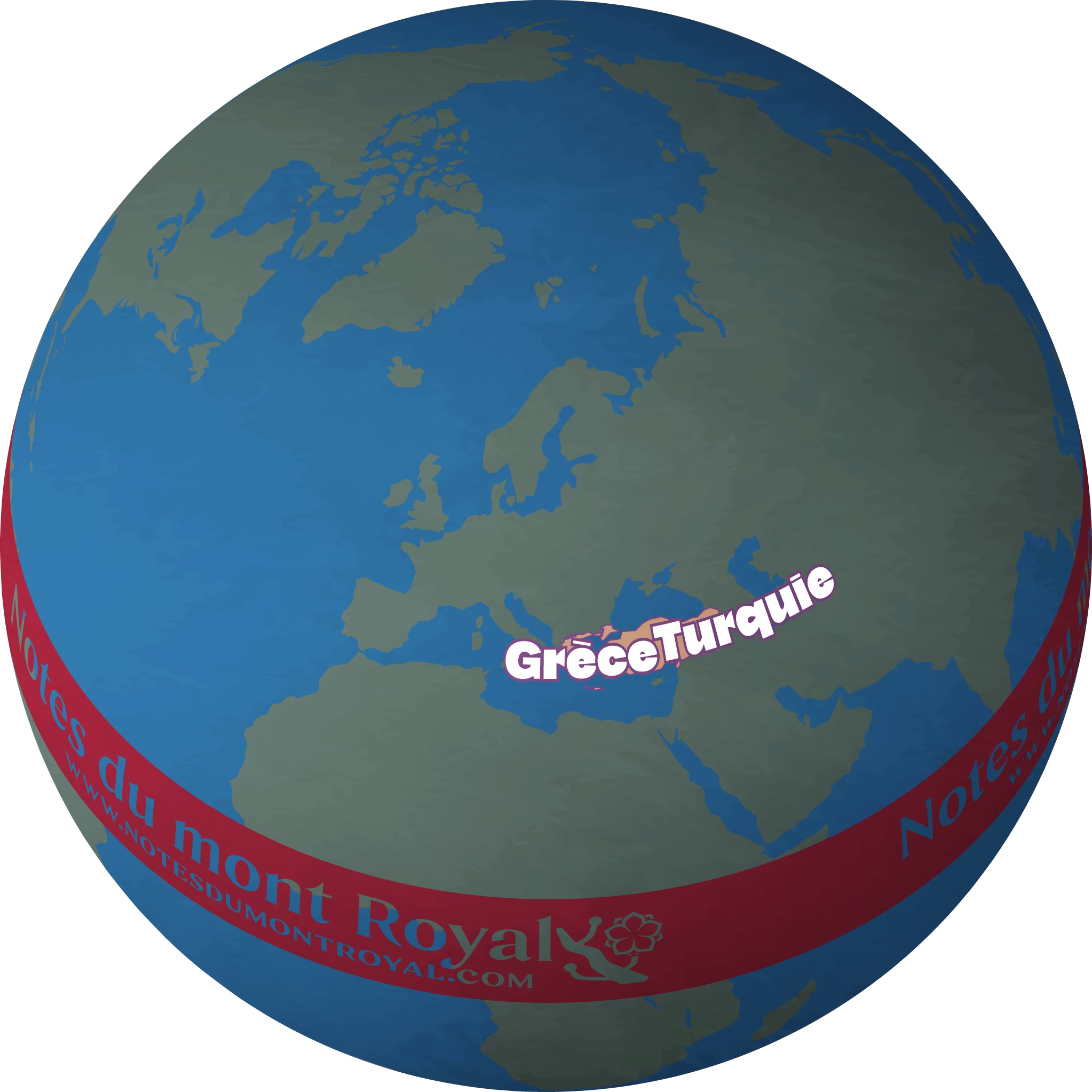
He Who Sought Himself: The Grandeur and Solitude of Heraclitus
Translated from French • English (anglais)
Heraclitus of Ephesus reaches us, from the depths of ages, through the fragments of a scroll deposited, in the 5th century BC, in the temple of Artemis. It is still debated whether this scroll was a continuous treatise, or whether it consisted of isolated thoughts, like those that the chance of quotation has preserved for us. Heraclitus expressed himself, in any case, in a sibylline, compact style, apt to astonish; he adopted at once the tone of a prophet and the language of a philosopher. Hence that epithet of the Obscure or Tenebrous (Σκοτεινός) so often affixed to his name, but which seems to me no less exaggerated: “Certainly [his] reading is rough and difficult to approach. The night is dark, the shadows are thick. But if an initiate guides you, you will see more clearly in this book than in broad daylight” (Greek Anthology, from the Palatine manuscript). The fragments that remain of his doctrine are like the flashes of a storm that had mysteriously withdrawn, rending the pre-Socratic night with a fire comparable to no other. Hegel, retracing the emergence of the “light of thought,” recognizes in Heraclitus the most radiantly central figure. Heidegger goes further: “Heraclitus is nicknamed ’the Obscure.’ Yet he is the Clear. For he says that which illuminates, trying to invite its light to enter the language of thought”1Heidegger, Martin, Essais et Conférences (Essays and Lectures), trans. from the German by André Préau, pref. by Jean Beaufret, Paris: Gallimard, coll. “Les Essais,” 1958..
The Royalty of Refusal
To this apparent obscurity was added, in Heraclitus, a core of pride and disdain for his fellow men. For when a philosopher is proud, he is never so by halves. A crown prince, he readily relinquished the royal dignity to his brother, then refused to legislate for a city he deemed irremediably “under the sway of a wretched constitution” (πονηρᾷ πολιτείᾳ). There he was, withdrawn in the sanctuary of Artemis, playing knucklebones with children. Did onlookers crowd around him? He would fling at them:
“Why do you marvel, scoundrels? Is it not better to do this than to lead the life of the city with you?” (Τί, ὦ κάκιστοι, θαυμάζετε; Ἢ οὐ κρεῖττον τοῦτο ποιεῖν ἢ μεθ’ ὑμῶν πολιτεύεσθαι;)
Diogenes Laertius, Book IX, trans. from the Greek by Jacques Brunschwig, in Vies et Doctrines des philosophes illustres (Lives and Doctrines of the Illustrious Philosophers), trans. under the direction of Marie-Odile Goulet-Cazé, Paris: Librairie générale française, coll. “La Pochothèque,” 1999.
This sage had need of no one, scorning even the society of scholars. For all that, he was not an insensible man; and when he grieved over the misfortunes that wove human existence, tears would rise to his eyes. “I have sought myself” (Ἐδιζησάμην ἐμεωυτόν), he confesses, as though he alone truly fulfilled the Delphic precept “Know thyself.” Nietzsche would feel the sacred terror of this self-sufficiency: “one cannot divine,” the philosopher of the will to power would say, “what the feeling of solitude was that pervaded the Ephesian hermit of the temple of Artemis, unless one finds oneself petrified with dread upon the most desolate and wildest of mountains”2Nietzsche, Friedrich, La Philosophie à l’époque tragique des Grecs (Philosophy in the Tragic Age of the Greeks), trans. from the German by Michel Haar and Marc de Launay, in Œuvres (Works). I, trans. under the direction of Marc de Launay, Paris: Gallimard, coll. “Bibliothèque de la Pléiade,” 2000..
The Vertigo of Universal Flux
While at the other extremity of the Greek world, the Eleatic school froze being in an icy immobility, Heraclitus conceived of unity as a river in perpetual motion, which remains the same although always different, the new waves ceaselessly driving the old ones before them3By this image, Heraclitus does not merely say that existence is subject to vicissitudes and declines, but that no thing is this or that: it becomes so. The world resembles the kykeon (κυκεών), that mixture of wine, grated cheese, and barley flour, whose thick consistency owes its unity only to agitation. When the stirring ceases, the elements dissociate, the heavy sinks back, and this ritual beverage is no more. Movement thus proves constitutive of the union of opposites: “Even the kykeon decomposes if one does not stir it” (Καὶ ὁ κυκεὼν διίσταται μὴ κινούμενος).. Against the common illusion of permanence, nothing is stable: “Everything flows” (Πάντα ῥεῖ), “Everything is becoming” (Hegel), “All things […] totter ceaselessly […]. I do not paint being. I paint the passage” (Montaigne).
The flowing of all things has this consequence: everything converts into its opposite. If being exists only in change, it is inevitably a middle ground between two opposing terms; at every instant, one stands before that elusive boundary where two contrary qualities meet. A terrible law that applies to the human being himself, whose every age is the death of the one before:
“Has not the nursling vanished in the child, and the child in the boy, the youth in the adolescent, the adolescent in the young man, then […] the grown man in the old man […]? Perhaps […] nature silently teaches us not to dread the final death?”
Philo of Alexandria, De Iosepho, trans. from the Greek by Jean Laporte, Paris: Éditions du Cerf, coll. “Les Œuvres de Philon d’Alexandrie,” 1964.
The Aesthetics of the Cosmic Game
In search of a tragic affirmation of life, Nietzsche would make the hermit of Ephesus his closest ancestor. “The world, in its eternal need for truth, has […] eternally need of Heraclitus,” he would declare. And elsewhere:
“[…] the company of Heraclitus puts me more at ease and comforts me more than any other. The acquiescence in impermanence and annihilation; the ”yes“ spoken to contradiction and war; becoming, implying the refusal of the very notion of ”being“ — in this, I must recognize […] the thought nearest to my own that has ever been conceived.”
Nietzsche, Friedrich, L’Antéchrist (The Antichrist), followed by Ecce homo, trans. from the German by Jean-Claude Hémery, Paris: Gallimard, coll. “Folio,” 1974.
What the German philosopher would find there above all was the antidote to Schopenhauerian pessimism. Far from bending beneath the yoke of supposed faults, injustices, contradictions, sufferings, reality frees itself from all morality: it is “a child playing, pushing pieces on a board: the kingship of a child” (παῖς […] παίζων, πεσσεύων· παιδὸς ἡ βασιληίη). If Heraclitus mingled with noisy children at play in the sanctuary of Artemis, it was because he was already meditating there on the “game of the great world-child,” that is to say, God. The will to power takes shape here in Nietzsche’s mind: an artist-force that builds and destroys, with the sublime innocence of a child placing a few pebbles here and there, or piling up heaps of sand only to topple them again, beyond good and evil. It is in the footsteps of the Obscure that Nietzsche “prepares to become the Antichrist, that is, he who rejects the moral significance of the world.”
Further Reading
On Héraclite : la lumière de l’Obscur (Heraclitus: The Light of the Obscure)
Quotations
“Ἀκοῦσαι οὐκ ἐπιστάμενοι οὐδ᾽ εἰπεῖν. • Ψυχῆς πείρατα ἰὼν οὐκ ἂν ἐξεύροιο πᾶσαν ἐπιπορευόμενος ὁδόν· οὕτω βαθὺν λόγον ἔχει. • Ποταμοῖς τοῖς αὐτοῖς ἐμβαίνομέν τε καὶ οὐκ ἐμβαίνομεν, εἶμέν τε καὶ οὐκ εἶμεν.”
Αποσπάσματα (Ηράκλειτος) on Wikisource ελληνικά, [online], accessed February 22, 2026.
“Not being versed in listening, they do not know how to speak either. • You would not find the limits of the soul, even by traveling all the roads, so deep is its logos. • We step and do not step into the same rivers; we are and we are not.”
Heraclitus of Ephesus, Héraclite : la lumière de l’Obscur (Heraclitus: The Light of the Obscure), trans. from the Greek by Jean Bouchart d’Orval, pref. by Constantin Fotinas. Montreal: Éditions du Roseau, 1997; repr., Gordes: Les Éditions du Relié, coll. “Poche,” 2007.
“Not knowing how to listen, they do not know how to speak either. • You would not find the limits of the soul, even traveling all the roads, so deep a discourse (λόγον) does it hold. • We step and do not step into the same rivers; we are and we are not (there).”
Heraclitus of Ephesus, Fragments, trans. from the Greek by Marcel Conche, Paris: Presses universitaires de France, coll. “Épiméthée,” 1986; repr. under the title Fragments recomposés : présentés dans un ordre rationnel (Recomposed Fragments: Presented in a Rational Order), Paris: PUF, 2017.
“They know neither how to listen, nor how to speak. • Even if you traveled all the paths, you would never find the limits of the soul, so deep is the knowledge it possesses. • We go down into the same rivers and do not go down; we are there and we are not.”
Heraclitus of Ephesus, Fragments : citations et témoignages (Fragments: Quotations and Testimonies), trans. from the Greek by Jean-François Pradeau, Paris: Flammarion, coll. “GF,” 2002.
“They know neither how to listen, nor even how to speak. • Limits of the soul, you could not find them by pursuing your way / However long the entire road / So deep is the logos it contains. • Into the same rivers / We step and we do not step / We are and we are not.”
Dumont, Jean-Paul (ed.), Les Présocratiques (The Pre-Socratics), trans. from the Greek by Jean-Paul Dumont, with the collaboration of Daniel Delattre and Jean-Louis Poirier, Paris: Gallimard, coll. “Bibliothèque de la Pléiade,” 1988.
“Incapable of listening, no more (than) of speaking. • And the limits of the soul, where you go, you will not discover, even if you travel all the roads, so deep is its logos. • Into the same rivers we step and do not step, we are and are not.”
Heraclitus of Ephesus, Héraclite d’Éphèse, les vestiges (Heraclitus of Ephesus, the Vestiges). III.3.B/i, Les Fragments du livre d’Héraclite (The Fragments of the Book of Heraclitus), trans. from the Greek by Serge Mouraviev [Sergueï Nikititch Mouraviev], Sankt Augustin: Academia Verlag, coll. “Heraclitea,” 2006.
“Those people who know neither how to listen nor how to speak. • The limits of the soul, you could not reach them, even by traveling the entire road, so deep a logos it holds. • Into the same rivers, we step and we do not step, we are and we are not.”
Heraclitus of Ephesus, Les Fragments d’Héraclite (The Fragments of Heraclitus), trans. from the Greek by Roger Munier, Toulouse: Fata Morgana, coll. “Les Immémoriaux,” 1991.
“Men, who hear and speak without knowing. • The frontiers of the soul, you could not reach them however far, on all the roads, your steps may lead you: so deep is the word that dwells within it. • We step and we do not step into the same rivers, we are and are not.”
Battistini, Yves (ed.), Trois Contemporains : Héraclite, Parménide, Empédocle (Three Contemporaries: Heraclitus, Parmenides, Empedocles), trans. from the Greek by Yves Battistini, Paris: Gallimard, coll. “Les Essais,” 1955; repr. expanded under the title Trois Présocratiques (Three Pre-Socratics), Paris: Gallimard, coll. “Idées,” 1968.
“They know neither how to listen nor even how to speak. • [lacuna] • We go down and we do not go down into the same river, we are and are not.”
Tannery, Paul, Pour l’histoire de la science hellène : de Thalès à Empédocle (Toward a History of Hellenic Science: From Thales to Empedocles), Paris: F. Alcan, 1887; repr. (pref. by Federigo Enriques), Paris: Gauthier-Villars, 1930.
“Those people who know neither how to listen nor how to speak. • One cannot find the limits of the soul, whatever path one takes, so deeply embedded are they. • We go down and we do not go down into the same river; we are and we are not.”
Voilquin, Jean (ed.), Les Penseurs grecs avant Socrate : de Thalès de Milet à Prodicos (Greek Thinkers Before Socrates: From Thales of Miletus to Prodicus), trans. from the Greek by Jean Voilquin, Paris: Librairie Garnier Frères, coll. “Classiques Garnier,” 1941; repr., Paris: Garnier-Flammarion, coll. “GF,” 1964.
“Not being capable of listening, no more of speaking. • Of limits to the ”psukhè“ during its journey, he would not discover them, the man who would take all the paths: it has so deep a logos. • Into the same rivers, we step and we do not step, we are and we are not.”
Heraclitus of Ephesus, Fragments, trans. from the Greek by Frédéric Roussille, with the collaboration of Éliane Gaillard and François Barboux, Paris: Éditions Findakly, 1984.
“Delight is there, but some know neither how to see it nor how to hear it. • You will never find the limits of the vital breath (”psyche“), even by traveling all the roads, for the bliss of its delight is infinite. • We step and do not step into the same rivers, we are and are not.”
Heraclitus of Ephesus, Les Fragments d’Héraclite (The Fragments of Heraclitus), trans. from the Greek by Guy Massat, [Sucy-en-Brie]: Anfortas, 2018.
“Not knowing how to listen, they do not know how to speak either. • [lacuna] • Into the same rivers, we step and we do not step; we are and we are not.”
Plazenet, Laurence (ed.), Anthologie de la littérature grecque : de Troie à Byzance (Anthology of Greek Literature: From Troy to Byzantium), trans. from the Greek by Emmanuèle Blanc, [Paris]: Gallimard, coll. “Folio Classique,” 2020.
“Not knowing how to listen or speak. • The confines of the soul, in your march, you will not discover them, even if you travel every path; it contains so deep a logos. • We step and do not step into the same rivers, we are and are not.”
Axelos, Kostas, Héraclite et la Philosophie : la première saisie de l’être en devenir de la totalité (Heraclitus and Philosophy: The First Grasp of Being in the Becoming of Totality), Paris: Les Éditions de Minuit, coll. “Arguments,” 1962.
“They know neither how to hear, nor how to speak. • You would find no limit to the soul, even by voyaging on all the roads, so deep a logos it has. • We step and we do not step into the same rivers. We are and we are not.”
Ramnoux, Clémence, Héraclite ou l’homme entre les choses et les mots (Heraclitus, or Man Between Things and Words), pref. by Maurice Blanchot, Paris: Les Belles Lettres, coll. “Collection d’études anciennes,” 1959.
“As they do not know how to listen, they do not know how to speak either. • The limits of the breath, he would not discover them on his way, the man who would take them all. So deep is the reason he holds. • Into the same rivers, we step and we do not step, we are and we are not.”
Heraclitus of Ephesus, Héraclite ou la séparation (Heraclitus, or Separation), trans. from the Greek by Jean Bollack and Heinz Wismann. Paris: Les Éditions de Minuit, coll. “Le Sens commun,” 1972.
“Incapable are they of listening as well as of speaking. • The utmost point of the soul, one could not reach it by walking, even if one went to the end of the road. For the originary cause extends deep within it. • Into the same rivers we step and do not step. Just as we exist and do not exist.”
Heraclitus of Ephesus, Les Fragments (The Fragments), trans. from the Greek by Simonne Jacquemard, followed by Héraclite d’Éphèse ou le flamboiement de l’Obscur (Heraclitus of Ephesus, or the Blaze of the Obscure) by the same author, Paris: Arfuyen, coll. “Ombre,” 2003.
“Not knowing how to listen or even how to speak. • You could not discover the limits of the soul, / Even if you traveled all the roads, / So deep a logos it harbors. • Into the same rivers we step and do not step, / We are and are not.”
Heraclitus of Ephesus, Éclats d’horizon : 150 fragments d’Héraclite d’Éphèse (Shards of the Horizon: 150 Fragments of Heraclitus of Ephesus), trans. from the Greek by Linda Rasoamanana, pref. by Yves Battistini, Nantes: Éd. Amalthée, 2007.
“Not knowing how to listen / They do not know how to speak either. • Bounds of the soul / He would not discover them / He who would travel all paths / So deep is the logos it gathers. • Into the same rivers / We step and we do not step / We are and we are not.”
Oriet, Blaise, Héraclite ou la philosophie (Heraclitus, or Philosophy), Paris: L’Harmattan, coll. “Ouverture philosophique,” 2011.
“They know neither how to listen, nor how to speak. • The bounds of the soul, whatever path you travel, you could not discover them, so deep a reason it contains. • We go down and do not go down into the same river, we are and are not.”
Heraclitus of Ephesus, Doctrines philosophiques (Philosophical Doctrines), trans. from the Greek by Maurice Solovine, Paris: F. Alcan, 1931.
“[lacuna] • One cannot find the limits of the soul, even by traveling the entire road, so deep a λόγος it has. • We step and do not step, we are and are not in the same rivers.”
Weil, Simone, La Source grecque (The Greek Source), Paris: Gallimard, coll. “Espoir,” 1953.
“Not knowing how to listen or speak. • You will not find the limits of the soul, whatever direction you travel in, so deep is its measure. • We go down and do not go down into the same rivers; we are and are not.”
Burnet, John, L’Aurore de la philosophie grecque (The Dawn of Greek Philosophy), trans. from the English by Auguste Reymond, Paris: Payot & Cie, 1919.
Downloads
Sound Recordings
- Heinz Wismann on Héraclite : la lumière de l’Obscur (Heraclitus: The Light of the Obscure). (France Culture).
- Hervé Pasqua on Héraclite : la lumière de l’Obscur (Heraclitus: The Light of the Obscure). (YouTube).
- Jean-Claude Ameisen on Héraclite : la lumière de l’Obscur (Heraclitus: The Light of the Obscure). (France Inter).
- Jean-François Pradeau on Héraclite : la lumière de l’Obscur (Heraclitus: The Light of the Obscure). (France Culture).
- Jérôme Stéphan on Héraclite : la lumière de l’Obscur (Heraclitus: The Light of the Obscure). (Jérôme Stéphan).
- Kostas Axelos, Jean Beaufret, and François Châtelet on Héraclite : la lumière de l’Obscur (Heraclitus: The Light of the Obscure). (France Culture).
- Marc Ballanfat on Héraclite : la lumière de l’Obscur (Heraclitus: The Light of the Obscure). (France Culture).
- Philippe Choulet on Héraclite : la lumière de l’Obscur (Heraclitus: The Light of the Obscure). (France Culture).
- Thibaut de Saint Maurice on Héraclite : la lumière de l’Obscur (Heraclitus: The Light of the Obscure). (France Culture).
- Émilie Hanns on Héraclite : la lumière de l’Obscur (Heraclitus: The Light of the Obscure). (Octopus, le philosophe à tentacules).
Printed Works
- Excerpt from Héraclite : la lumière de l’Obscur (Heraclitus: The Light of the Obscure) in the translation by Blaise Oriet (2011). (L’Harmattan).
- Excerpt from Héraclite : la lumière de l’Obscur (Heraclitus: The Light of the Obscure) in the translation by Jean-François Pradeau (2019). (Éditions Flammarion).
- Excerpt from Héraclite : la lumière de l’Obscur (Heraclitus: The Light of the Obscure) in the translation by Marcel Conche (2017). (Presses universitaires de France (PUF)).
- Indirect translation of Héraclite : la lumière de l’Obscur (Heraclitus: The Light of the Obscure) by Auguste Reymond, after that of John Burnet (1919). (Google Books).
- Indirect translation of Héraclite : la lumière de l’Obscur (Heraclitus: The Light of the Obscure) by Auguste Reymond, after that of John Burnet (1919), copy. (Canadian Libraries).
- Partial translation of Héraclite : la lumière de l’Obscur (Heraclitus: The Light of the Obscure) by Paul Tannery (1887). (Google Books).
- Partial translation of Héraclite : la lumière de l’Obscur (Heraclitus: The Light of the Obscure) by Paul Tannery (1887), copy. (Google Books).
- Partial translation of Héraclite : la lumière de l’Obscur (Heraclitus: The Light of the Obscure) by Paul Tannery (1887), copy 2. (Canadian Libraries).
- Partial translation of Héraclite : la lumière de l’Obscur (Heraclitus: The Light of the Obscure) by Paul Tannery (1887), copy 3. (Google Books).
- Partial translation of Héraclite : la lumière de l’Obscur (Heraclitus: The Light of the Obscure) by Paul Tannery (1887), copy 4. (Google Books).
- Partial translation of Héraclite : la lumière de l’Obscur (Heraclitus: The Light of the Obscure) by Paul Tannery (1930). (Bibliothèque nationale de France (BnF)).
- Partial translation of Héraclite : la lumière de l’Obscur (Heraclitus: The Light of the Obscure) by Paul Tannery (electronic ed.). (Wikisource).
- Partial translation of Héraclite : la lumière de l’Obscur (Heraclitus: The Light of the Obscure) by Simone Weil (1953). (Google Books).
- Partial translation of Héraclite : la lumière de l’Obscur (Heraclitus: The Light of the Obscure) by Simone Weil (electronic ed.). (Wikisource).
- Edition and translation of Héraclite : la lumière de l’Obscur (Heraclitus: The Light of the Obscure) by Guy Massat (electronic ed.). (Guy Massat).
Bibliography
- Aurobindo, Shri, Héraclite (Heraclitus), trans. from the English by D. N. Bonarjee and Jean Herbert, pref. by Mario Meunier, Paris: Dervy-Livres, 1970.
- Beaufret, Jean, Dialogue avec Heidegger (Dialogue with Heidegger). I, Philosophie grecque (Greek Philosophy), Paris: Les Éditions de Minuit, coll. “Arguments,” 1973.
- Bouchart d’Orval, Jean, Civilisation profane : la perte du sacré (Profane Civilization: The Loss of the Sacred), Montreal: Éditions du Roseau, 1987.
- Cantin-Brault, Antoine, Penser le néant : Hegel, Heidegger et l’épreuve héraclitéenne (Thinking Nothingness: Hegel, Heidegger, and the Heraclitean Ordeal), Quebec City: Presses de l’Université Laval, coll. “Zêtêsis,” 2018.
- Decharneux, Bernard and Inowlocki, Sabrina, Philon d’Alexandrie : un penseur à l’intersection des cultures gréco-romaine, orientale, juive et chrétienne (Philo of Alexandria: A Thinker at the Intersection of Greco-Roman, Eastern, Jewish, and Christian Cultures), Brussels: E.M.E., 2009.
- Goedert, Georges, Nietzsche critique des valeurs chrétiennes : souffrance et compassion (Nietzsche as Critic of Christian Values: Suffering and Compassion), Paris: Beauchesne, 1977.
- Janicaud, Dominique, Hegel et le Destin de la Grèce (Hegel and the Destiny of Greece), Paris: Librairie philosophique J. Vrin, coll. “Bibliothèque d’histoire de la philosophie,” 1975.
- Jeannière, Abel, La Pensée d’Héraclite d’Éphèse et la Vision présocratique du monde (The Thought of Heraclitus of Ephesus and the Pre-Socratic Vision of the World), with the complete translation of the fragments, Paris: Aubier-Montaigne, 1959.
- Romilly, Jacqueline de, Précis de littérature grecque (Handbook of Greek Literature), Paris: Presses universitaires de France, 1980.
- Steiner, George, Poésie de la pensée (The Poetry of Thought), trans. from the English by Pierre-Emmanuel Dauzat, Paris: Gallimard, coll. “NRF Essais,” 2011.
- Zeller, Édouard, La Philosophie des Grecs considérée dans son développement historique (The Philosophy of the Greeks Considered in Its Historical Development). II, Les Éléates, Héraclite, Empédocle, les Atomistes, Anaxagore, les Sophistes (The Eleatics, Heraclitus, Empedocles, the Atomists, Anaxagoras, the Sophists), trans. from the German by Émile Boutroux, Paris: Hachette, 1882. (Google Books).